Viruses aren't on a MERV rating chart. Neither is the finest wildfire smoke, or the smell of the garlic you sautéed last night. That surprises a lot of people. The chart only reports how well a filter traps particles between 0.3 and 10 microns, because that's the window ASHRAE Standard 52.2 tests.
Don't take your indoor air for granted! Particles smaller than that window and debris larger than it still move through your home. So do gases, which the test never measures at all. An HVAC technician can help you understand these limitations and choose the right filtration system for your home.
TL;DR Quick Answers
MERV rating chart
A MERV rating chart shows the minimum share of particles a filter captures in three size bands from 0.3 to 10 microns, on a scale of 1 to 16. Higher numbers catch smaller particles. Read each rating as a floor for one size window, because the chart never grades gases, odors, or particles under 0.3 microns.
The three bands: E1 covers 0.3 to 1.0 microns, E2 covers 1.0 to 3.0, and E3 covers 3.0 to 10.0.
MERV 8: Captures at least 70% of E3 particles and 20% of E2, enough for everyday dust, pollen, and pet dander.
MERV 11: Adds at least 20% of E1, plus 65% of E2 and 85% of E3.
MERV 13: Captures at least 50% of E1, 85% of E2, and 90% of E3, the finest common choice for homes.
What the chart leaves out: VOCs, odors, and the efficiency charged filters lose over time. Ask for a MERV-A rating when one is published.
Before you upgrade: Check your system’s pressure drop limit, since denser media pushes back harder on airflow.
Top Takeaways
The chart's window: MERV reports capture only for particles from 0.3 to 10 microns.
What falls outside it: Particles under 0.3 microns and debris over 10 microns sit outside the tested bands.
Gases don't count: MERV doesn't measure VOCs, odors, ozone, radon, or carbon monoxide.
Performance drift: Charge loss, air bypass, and short fan runtime can drag a filter below its label.
The scale tops out at 16: Any chart showing MERV 17 to 20 is outdated.
What a MERV Rating Chart Actually Measures
MERV stands for Minimum Efficiency Reporting Value, and ASHRAE introduced the scale in 1987. Lab testers load a filter with dust, then count particles on both sides of it across 12 size channels. They group those counts into three bands. E1 covers 0.3 to 1.0 microns, E2 covers 1.0 to 3.0, and E3 covers 3.0 to 10.0.
Every rating reflects the lowest efficiency the filter posted during that dusty test run. Think of it as a floor, not a peak. Today's scale runs from MERV 1 to MERV 16, and you can brush up on each column with how to read the standard chart.
The Particles a MERV Rating Chart Leaves Out
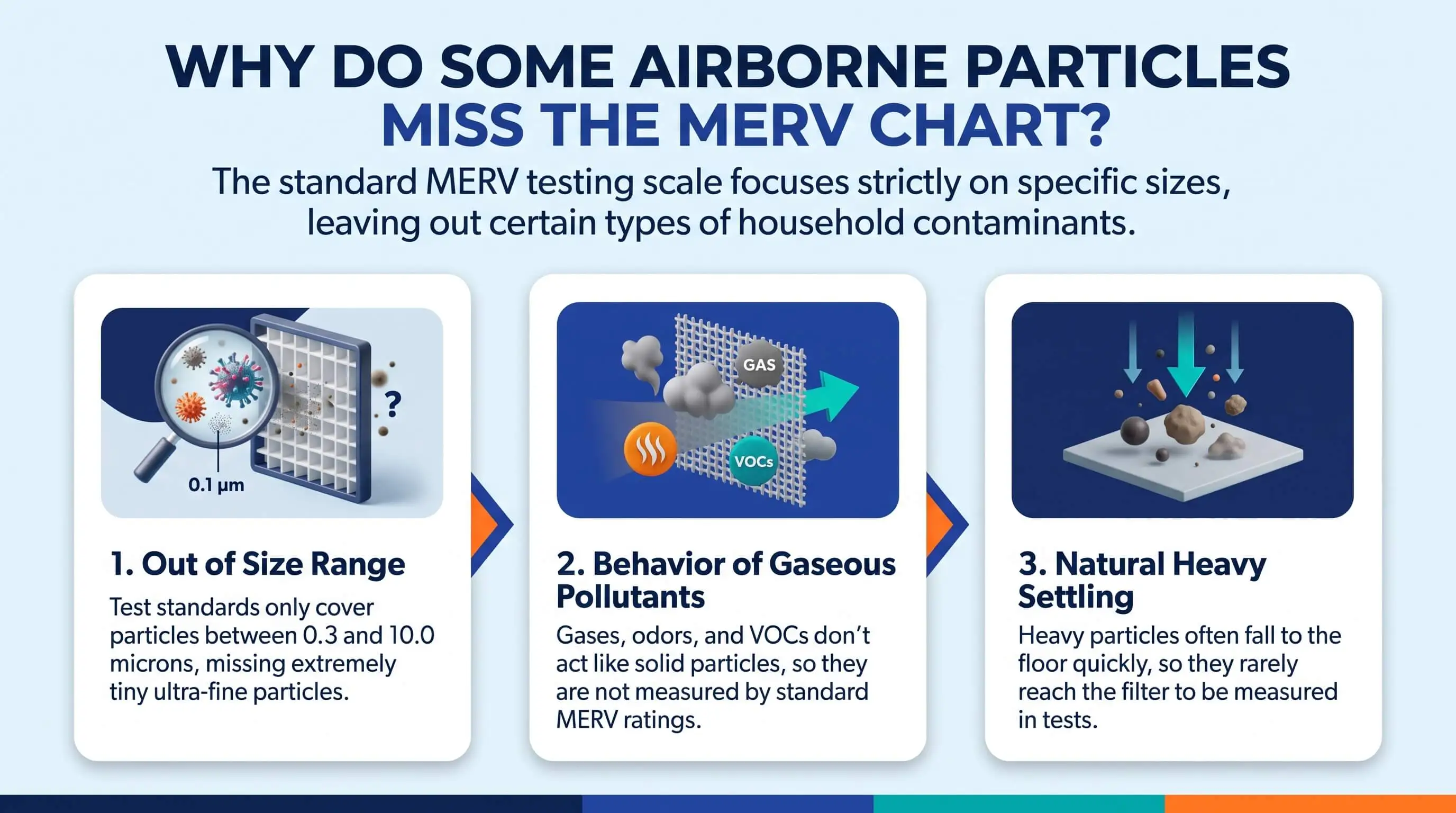
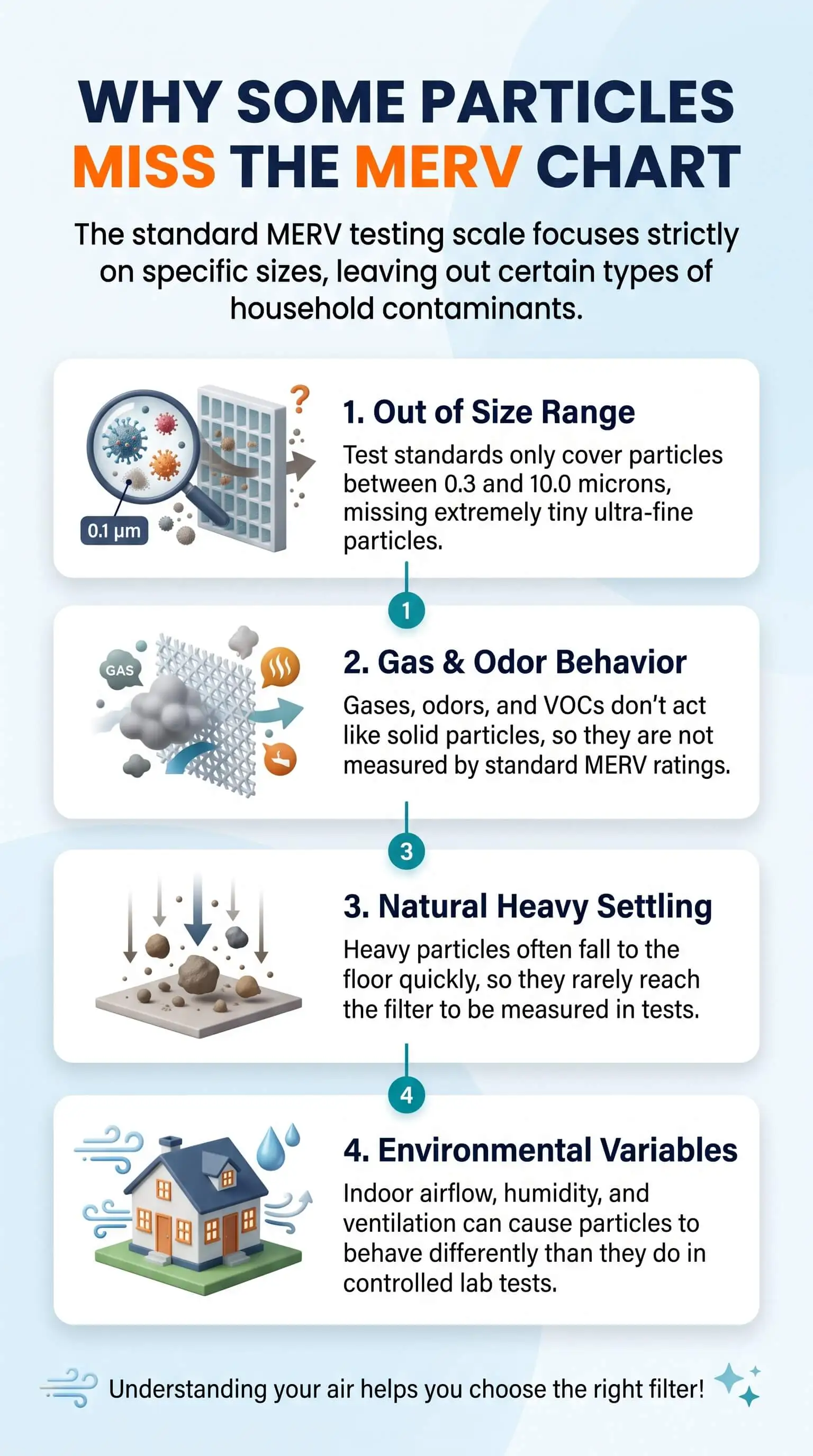
Particles Smaller Than 0.3 Microns
Single virus particles live down here, along with much of the fine fraction in combustion smoke. The test doesn't measure this range, so the chart says nothing about it. Your filter still catches plenty of them. Capture tends to dip for particles around 0.1 to 0.3 microns, then climbs again as the tiniest ones drift into the fibers on their own.
Particles Larger Than 10 Microns
Lint, hair, and heavy dust are easy catches for almost any filter. Many of them never get the chance, though. They settle onto floors and furniture before they reach the return grille. For MERV 1 to 4, ASHRAE relies on a separate arrestance test with synthetic dust instead of the three E bands.
What a Dash on the Chart Really Means
A dash in a chart column means the standard sets no minimum there. Your filter may still catch plenty in that band. Under the current table, E1 requirements kick in at MERV 11 and E2 requirements start at MERV 8. A MERV 8 filter traps some submicron particles too, even though the standard doesn't ask it to.
Gases, Odors, and VOCs Never Make the Chart
Here's something that might surprise you: MERV measures particles only. Volatile organic compounds, cooking odors, ozone, radon, and nitrogen dioxide slip through a MERV 13 filter about as easily as they slip through a MERV 8.
Stopping gases takes adsorbent media such as activated carbon, and each sorbent targets specific gas types. Carbon won't touch carbon monoxide. That one calls for source control and a working CO alarm. You also won't find a widely used performance rating for gas removal, which means a carbon filter's label never lines up with a MERV rating chart.
Why the Chart Can Overstate Real-World Performance
Electrostatic Charge Loss and MERV-A
Plenty of pleated filters ship with an electrostatic charge that helps them grab fine particles. Dust coats the fibers over time, the charge fades, and efficiency slides with it. ASHRAE built an optional conditioning step, Appendix J, to measure that drop, and labs report the result as MERV-A. When a manufacturer publishes a MERV-A number, that's the figure I trust more.
Air That Slips Around the Filter
Leave a gap between the filter and its slot, and dirty air takes the shortcut around the media. ASHRAE points out that a lower-efficiency filter with a snug seal can beat a higher-efficiency filter that leaks.
Fan Runtime and Pressure Drop
Your filter only cleans air while the blower runs. Many systems sit idle most of the day. The chart also leaves out pressure drop, even though a filter can eat up 20 to 50 percent of a home system's pressure budget. Push resistance too high and airflow drops, run times stretch, and in humid climates the coil may ice up. I check resistance before weighing any MERV 13 upgrade.
Why MERV 17 to 20 Isn't on Current Charts
You'll still spot MERV 17 through 20 on older charts. Those grades don't exist anymore. In 2023, the chair of the ASHRAE committee that maintains Standard 52.2 put out a correction confirming that the scale ends at MERV 16. Labs test HEPA filters under a different method, so any chart running to 20 is out of date.
How I Fill the Gaps a MERV Rating Chart Leaves
Ask for the test data: Request the full ASHRAE 52.2 report or a MERV-A value, especially for charged media.
Check pressure drop first: Hold the filter's rated resistance up against your equipment's limit before you move up in MERV.
Seal the slot: Confirm the exact filter size and close any gap around the frame.
Add carbon for odors: Pick a filter or air cleaner with a meaningful amount of activated carbon when smells or VOCs are the problem.
Run the fan during smoke events: Switch the thermostat fan to On so air keeps moving through the filter.
Size room cleaners by CADR: Match a portable unit's clean air delivery rate to the room's square footage.
Go after the sources: Vent cooking fumes, keep solvents out of the living space, and make sure your CO alarm works.
Pro Tip: Since 2019, California has required filter labels to list MERV, particle efficiency, and pressure drop. If your filter carries that label, compare resistance right alongside capture.
"When I pull a two-month-old pleated filter and set it next to its box, the MERV printed there describes the day the factory built it, not the day I took it out. Dust buries the charge that helps the media grab submicron particles, so I ask for a MERV-A number whenever a manufacturer publishes one."
7 Essential Resources
MERV Rating Chart, Range, and Scale: The full 1 to 16 chart with E1, E2, and E3 minimums, micron sizes, and airflow guidance.
New York State Department of Health: Indoor Air Cleaners: Why MERV covers particles only, and how activated carbon handles indoor gases.
North Carolina DHHS: Air-Cleaning Devices: How gas-phase sorbents go after specific pollutants, and why ozone generators fall short.
NAFA: Correction Regarding the Terms MERV 17 to 20: The standards committee statement that the MERV scale ends at 16.
ASHRAE: Filtration and Disinfection: MERV-A guidance for charged media, plus why a tight filter seal matters.
California Air Resources Board: Selecting a Portable Air Cleaner: Room size ratings and placement tips for single-room cleaners.
Building America Solution Center: High-MERV Filters Explained: Pressure drop budgets, filter sizing, and bypass options for higher MERV ratings.
3 Supporting Statistics
Americans spend about 90 percent of their time indoors, where some pollutants run two to five times higher than typical outdoor levels. EPA Report on the Environment: Indoor Air Quality
Median residential HVAC runtime sits around 18 percent, so for more than 80 percent of the time, air isn't passing through even a very good filter. National Academies: Indoor Particulate Matter Exposure Control and Mitigation
Researchers in a 2016 study hosted by the National Library of Medicine found that an electret filter medium caught about 98 percent of PM1.0 when clean, then fell to roughly 60 percent after the equivalent of about 90 days at 8 hours a day. PubMed Central: Ultrafine Particle Removal Study
Final Thoughts and Opinion
I think a MERV rating chart is one of the most useful tools a homeowner has, as long as you read it as a map of one size window. It shows how a filter handles 0.3 to 10 micron particles in a lab. Gases never appear on it. Neither does charge loss, or the gap around your filter slot.
I'd pick a well-sealed MERV 11 with the fan running over a loose MERV 13 that only sees air a few hours a day. Match the rating to what your system can handle. Then use carbon, steady airflow, and source control to cover what the chart misses.
Frequently Asked Questions
Does a MERV Rating Chart Cover Viruses?
Not directly. A single virus particle measures smaller than 0.3 microns, below the chart's range. Most airborne viruses travel inside larger respiratory particles, though, and those land in the E1 and E2 bands. That's why you'll see MERV 13 or higher recommended for infectious aerosols.
Can a MERV 13 Filter Remove Odors or VOCs?
No. MERV 13 tells you about particle capture and nothing else. Odors and VOCs are gases, so you need adsorbent media like activated carbon, with enough of it in the filter to make a measurable difference.
What Does MERV-A Mean on a Filter Label?
It's the rating a filter earns after ASHRAE's optional Appendix J conditioning step, which mimics the charge loss filters go through in use. MERV-A usually comes in equal to or lower than the standard MERV. It gives you a closer picture of how the filter performs once it's been in service.
Is There Such a Thing as a MERV 17 to 20 Filter?
Not under the current standard, which ends at MERV 16. Labs test HEPA filters under different methods. Any chart or product calling itself MERV 17 to 20 leans on outdated or unofficial terms.
Why Doesn't a MERV Rating Chart Show Pressure Drop?
The chart only summarizes capture efficiency. You'll find pressure drop in the full ASHRAE 52.2 test report and on some filter labels. Compare it with your equipment's rated limit before you move to a higher MERV.
See Past the Gaps in Your MERV Rating Chart
You're the hero of your household when it comes to clean air, and that includes knowing what the label leaves out. Check your filter's MERV-A and pressure drop to help determine the best air filter MERV rating, seal the slot, then tell me in the comments which particles or odors you're working to keep out of your home.