A misdiagnosis from an unlicensed operator costs more than the repair itself. A contractor who skips permits transfers legal and financial risk directly onto the homeowner. A technician who recommends replacement on a system that needed a capacitor and a drain flush just sold a $6,000 solution to a $300 problem. We've seen all three scenarios play out in this community — more times than we'd like.
What makes finding a trustworthy HVAC company in Deltona harder than it should be isn't a shortage of contractors. It's a shortage of information. Florida's licensing requirements, Volusia County permit obligations, and the specific demands of Central Florida's year-round climate create real, meaningful differences between the companies operating in this market — differences that aren't visible in a Google search result or a five-star review.
This page closes that information gap. Here's what it covers:
How to verify credentials before authorizing any work.
What questions separate trustworthy contractors from problematic ones.
What red flags look like in practice — not just in theory.
What fair pricing reflects in a market where systems run harder and longer than anywhere north of Georgia.
Living in the same community raises the standard for what gets put on the line — and top HVAC system repair near Deltona FL reflects the level of care and professionalism every homeowner deserves before allowing any contractor to work on a neighbor’s home.
TL;DR Quick Answers
How to Find a Trustworthy HVAC Repair Company Near Deltona, FL
Finding a trustworthy HVAC company in Deltona comes down to verified credentials, transparent communication, and knowing what honest work looks like in Florida's regulated contracting market. Here's what matters most:
Verify three credentials — not one. Confirm an active Florida DBPR license at myfloridalicense.com, Volusia County registration separately, and NATE certification for the technician performing the diagnostic. A license confirms the legal minimum. The other two confirm actual competence.
Permits are not optional. Licensed contractors in Volusia County are required to pull permits for system replacements and significant component work. A contractor who skips permits isn't saving you money — they're transferring legal and financial risk onto your home.
Honest estimates are always itemized. A trustworthy repair quote separates parts, labor, permit costs, and warranty terms. A single bundled number with no breakdown is not a quote — it's a request for blind trust.
A lower price is not the same as a fair price. In a market where HVAC technician demand is growing faster than the supply of properly trained ones, price alone is a poor proxy for quality. Credentials, diagnostic accuracy, and first-time fix rates are what separate contractors worth hiring from the ones who are simply available.
Red flags appear before the work begins. Verbal quotes with no documentation, pressure to authorize immediately, and silence on permit requirements are patterns worth acting on — not explaining away.
A contractor who resists any of these questions has answered the most important one. Trustworthy HVAC companies in Deltona welcome credential verification, permit questions, and itemized estimate requests. These are the standards a good contractor already meets — not obstacles to hiring them.
Top Takeaways
Licensing is the floor — not the ceiling. Verify every contractor's active Florida DBPR license at myfloridalicense.com before work begins. Then go further — NATE certification, Volusia County registration, and permit compliance are what separate a licensed contractor from a trustworthy one.
The transparency gap is the homeowner's biggest risk. Deltona has no shortage of licensed HVAC contractors. It has a shortage of information that helps homeowners tell the difference between the ones who do the work correctly and the ones who do it cheaply. Knowing what questions to ask is the most valuable protection available before authorizing any repair.
Recurring repair patterns often trace back to improper installation — not bad luck. More than 65% of U.S. residential HVAC systems have been improperly installed. A system with early failures, uneven cooling, and rising energy bills may not need another repair. It may need someone to ask whether it was ever installed correctly.
A higher first-time fix rate is worth more than a lower estimate. NATE-certified technicians average 20.6% more completed work than non-certified counterparts — with fewer callbacks and better diagnostic accuracy. In a fast-growing market, certification is the clearest signal that the diagnosis will be right before the repair is authorized.
A contractor who resists scrutiny is giving you the most important answer they'll provide. Trustworthy contractors welcome credential checks, permit questions, and itemized estimates. These aren't obstacles to a good contractor. They are the standard a good contractor already meets.
What Makes an HVAC Company Trustworthy in Deltona's Market
Trust in the HVAC industry isn't built on five-star reviews alone. In Florida's regulated contracting environment, trustworthiness has a legal definition — and it starts with verifiable credentials. An active DBPR license confirms a contractor has met Florida's minimum requirements for HVAC work. NATE certification confirms a technician's skills have been independently tested beyond those minimums. Liability insurance confirms that if something goes wrong on your property, the financial responsibility stays where it belongs. In Deltona's market, where unlicensed operators are not uncommon, credentials aren't a courtesy check — they're the first filter every homeowner should run before a conversation goes any further.
The Questions That Separate Good Contractors From Great Ones
Licensing confirms a contractor is legal. Questions confirm whether they're worth hiring. The contractors we'd send to a neighbor's home are the ones who answer these without hesitation:
Can you provide your Florida DBPR license number for verification?
Will permits be pulled for this repair or replacement?
Is your diagnosis based on direct measurement or visual inspection alone?
What happens if the repair doesn't resolve the problem?
Can you walk me through both repair and replacement costs before I decide?
A contractor who slows down on any of those questions is telling you something. A contractor who answers all five clearly and without pressure is demonstrating exactly the kind of transparency that earns a long-term relationship in this community.
How to Read an Estimate Like a Technician
The estimate is where trust is either confirmed or lost. From our years of reviewing repair quotes with Deltona homeowners, here's what an honest estimate includes — and what its absence signals:
A line-item breakdown of parts and labor — not a single bundled number.
The specific component being replaced, with the part's function briefly explained.
Whether a permit is required and what that cost covers.
Labor warranty coverage and parts warranty duration.
A clear distinction between what the repair addresses and what it doesn't.
A single-number estimate isn't a quote. It's an ask for blind trust — and in a market where recurring misdiagnosis is more common than most homeowners realize, blind trust is expensive.
What Red Flags Actually Look Like in Deltona
Red flags in HVAC contracting don't always arrive with warning labels. In our experience serving this community, the situations that cost homeowners the most money rarely started with an obvious problem. They started with something small that was easy to dismiss:
A quote delivered verbally with no written documentation.
A technician who recommends full system replacement on the first visit without presenting repair as an option.
A price that comes in significantly below every other estimate without explanation.
An urgency pitch — "if we don't fix this today, your system will fail completely" — designed to prevent comparison shopping.
A contractor who becomes difficult to reach after the deposit is paid.
None of these signals are definitive on their own. Together, they form a pattern that experienced homeowners learn to recognize — and that top HVAC repair service professionals would flag immediately for any neighbor who described them.
Why Permit Requirements in Volusia County Matter More Than Most Homeowners Realize
Permits are the single most overlooked protection in the HVAC repair and replacement process — and the one most commonly exploited by contractors looking to reduce their costs at a homeowner's expense. In Volusia County, permits are required for system replacements and significant component work. That requirement exists because permitted work is inspected. Inspected work meets Florida Building Code. Work that meets code protects your home's value, validates your homeowner's insurance coverage, and creates a legal record that the installation was performed correctly. A contractor who skips permits isn't offering a discount. They're offloading risk — from their business onto your home.
The Local Climate Factor That Changes Every Calculation
What makes finding a trustworthy HVAC contractor meaningfully different from the same search in most other markets is Florida's climate. Central Florida's heat and humidity don't just make air conditioning more important — they change what competent HVAC service actually looks like in practice. Systems here run more months of the year, wear components faster, and accumulate condensate drain buildup at a rate that northern-trained technicians consistently underestimate. A contractor who understands this market treats twice-yearly maintenance as the standard, not the upsell. They price repairs with Florida's accelerated wear rates in mind. And they recognize that a system approaching ten years of Central Florida runtime is in a different conversation than a ten-year-old system in a cooler climate. Local knowledge isn't a marketing phrase. In Deltona's HVAC market, it's a meaningful technical differentiator.
How to Verify You're Hiring the Right Company
Before authorizing any HVAC repair or replacement near Deltona, take these steps in order:
Verify the contractor's Florida DBPR license at myfloridalicense.com — confirm the license is active and covers HVAC work.
Confirm permit requirements with Volusia County for the scope of work being proposed.
Request a written, itemized estimate — parts, labor, permit costs, and warranty terms clearly separated.
Check for NATE certification — ask specifically which technician will perform the work and whether they hold current certification.
Get at least two estimates — not to find the lowest price, but to establish a baseline for what honest work in this market costs.
Check Duke Energy Florida rebate eligibility if the repair conversation has moved toward replacement — the free Home Energy Check must be completed before installation begins to qualify.
A contractor who is worth hiring will support every one of these steps. A contractor who pushes back on any of them is giving you the most important information they'll provide before the work begins.
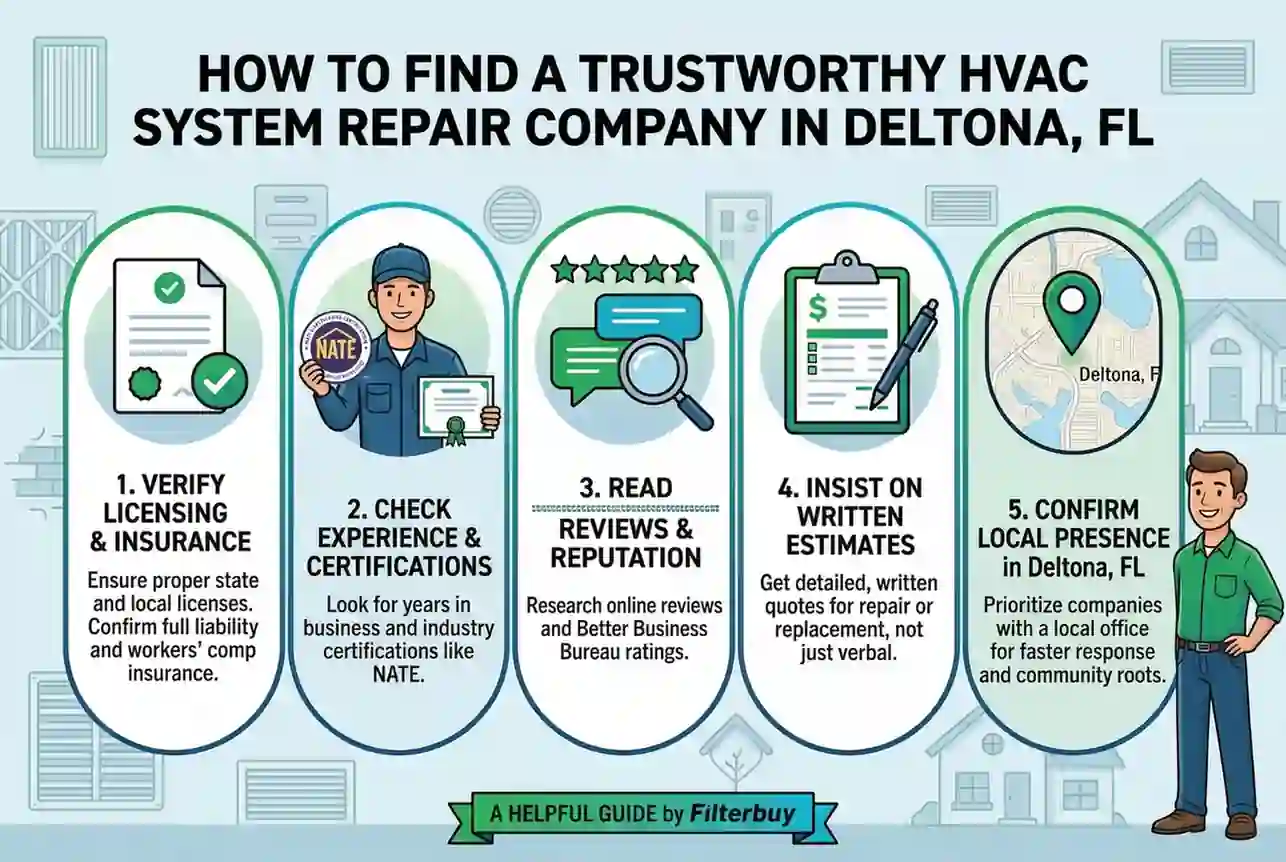
"The contractors who concern us most in this market aren't the ones who do bad work — they're the ones who do just enough to pass an initial inspection while cutting the corners that won't show up until the homeowner is dealing with a failed system two summers later. After years of serving Deltona, we've developed a simple measure of a contractor's character: show us how they handle the permit conversation, the repair-versus-replace conversation, and the estimate breakdown — and we can tell you almost everything you need to know about how they'll handle the work itself. Licensing tells you a contractor met the minimum bar to operate in Florida. How they communicate before the first tool comes out of the truck tells you whether they've actually earned the right to work in your home."
Essential Resources
Finding a trustworthy HVAC company in Deltona shouldn't require a background in contracting law. But in a market where licensing requirements, county registration rules, and consumer protection rights aren't common knowledge, the right resources make all the difference. These are the exact tools we'd walk a neighbor through before they hired anyone — including us.
Run This Lookup Before You Call Anyone Back We've seen what happens when this step gets skipped — and it's always harder to fix after the fact than before it. Every HVAC contractor working in Florida must hold an active DBPR license. This free verification takes less than a minute and is the single most important filter a Deltona homeowner can run before a repair conversation goes any further. https://www2.myfloridalicense.com/
The Consumer Protection Resource Florida's Attorney General Wants Every Homeowner to Have This is the page we'd bookmark before authorizing any contractor work — not just HVAC. Florida's Attorney General publishes direct, specific guidance on contractor red flags, how to evaluate written estimates, lien protection rights, and what legal recourse exists when a contractor engages in deceptive or high-pressure tactics. Reading this before signing anything is one of the most valuable fifteen minutes a Deltona homeowner can spend. https://www.myfloridalegal.com/consumer-protection/how-to-protect-yourself-contractors
State License Isn't Enough in Volusia County — Verify This Too This is one of the most overlooked steps in the contractor vetting process, and it's one we make a point of sharing with neighbors. State licensing and Volusia County registration are two separate requirements — and both matter. This official county resource lets homeowners verify contractor registration, confirm permit requirements for proposed HVAC work, and ensure the job will be independently inspected to Florida Building Code standards. https://www.volusia.org/services/growth-and-resource-management/building-and-zoning/contractor-licensing/
When Something Goes Wrong, This Is Where Deltona Homeowners Go Next We'd rather you never need this resource. But knowing it exists before work begins — not after — changes the dynamic of every contractor interaction that follows. If an HVAC contractor in Deltona performs substandard work, misrepresents pricing, or violates Florida contracting law, this is the official state channel for filing a formal complaint against a licensed contractor. https://www2.myfloridalicense.com/file-a-complaint/
The Credential That Separates a Tested Technician From a Licensed One After years of working in this community, we've come to see NATE certification as one of the clearest signals of genuine technical competence in the HVAC industry. A state license confirms a contractor met Florida's minimum bar. NATE certification confirms the technician diagnosing your system has been independently tested beyond that bar. This directory lets Deltona homeowners verify credentials and find NATE-certified professionals in the area before authorizing any work. https://www.natex.org/consumers/find-a-nate-certified-professional/
How to Identify Contractors Who Have Chosen to Be Held to a Higher Standard Not all licensed contractors are equal — and this resource helps make that distinction visible. ACCA's Quality Assured accreditation program holds contractors to ANSI-approved installation and maintenance standards adopted by utilities, government agencies, and manufacturers nationwide. When two contractors carry the same state license, ACCA QA accreditation is the kind of differentiator we'd look for if we were hiring someone to work on a neighbor's home. https://hvac-contractors.acca.org/qa-contractors
The Federal Resource We Share With Every Deltona Neighbor Facing a Major Repair Decision This is the guide we'd hand to anyone trying to evaluate a contractor, understand a repair quote, or decide whether repair or replacement makes more sense for their system. The EPA's comprehensive HVAC guide covers contractor selection, what a legitimate maintenance visit includes, repair-versus-replace decision frameworks, and energy-efficient equipment guidance — all in plain language, from a source with no stake in what you decide. https://www.energystar.gov/products/tools_resources/guide-energy-efficient-heating-and-cooling-hvac-guide
These essential resources help Deltona homeowners verify licenses, understand contractor protections, confirm county requirements, and evaluate technician credentials so they can identify top HVAC system repair professionals and avoid costly mistakes before authorizing any work.
Supporting Statistics
Years of service calls across Deltona and Central Florida taught us something no contractor directory shows: the numbers behind the HVAC industry reveal more about contractor quality — and the risk of choosing the wrong one — than most homeowners ever get to see.
HVAC technician employment is projected to grow 8% from 2024 to 2034 — more than twice the average growth rate for all occupations — with approximately 40,100 job openings projected annually over the decade.
We think about this every time a Deltona homeowner hires the first contractor that shows up in a search result. Here's what rapid industry growth actually means on the ground:
Demand for qualified HVAC technicians is outpacing the supply of properly trained ones.
The gap gets filled — and in our experience, it gets filled inconsistently.
The technician at your door may have two years of experience or twenty.
A state license confirms they cleared Florida's minimum bar. It says very little about what happens after the truck pulls up.
That gap between licensed and qualified is exactly what credentials like NATE certification were designed to close — and exactly why we treat them as a non-negotiable signal when evaluating any contractor we'd refer to a neighbor.
Source: U.S. Bureau of Labor Statistics, Occupational Outlook Handbook — https://www.bls.gov/ooh/installation-maintenance-and-repair/heating-air-conditioning-and-refrigeration-mechanics-and-installers.htm
More than 65% of U.S. residential HVAC systems have been improperly installed, causing equipment to consume 20%–30% more energy than necessary.
This is the statistic that reframes the most frustrating conversations we have with Deltona homeowners — the ones who've already paid two or three contractors and are still dealing with the same problem. In most cases, they're not dealing with a failing system. They're dealing with a system that was never right to begin with. Here's what improper installation looks like in practice:
Energy bills that don't match the system's age or rated efficiency.
Rooms that never cool evenly regardless of thermostat settings.
Components wear out faster than expected — capacitors, contactors, blower motors.
A history of recurring repairs that each seemed reasonable in isolation.
When we arrive at a Deltona home with that pattern, we don't start with the most recent failure. We start with the original installation. Because in more cases than we'd like, that's where the story begins — and where the only real fix starts.
Source: U.S. Department of Energy, Office of Energy Efficiency & Renewable Energy — https://www.energy.gov/eere/buildings/articles/optimizing-installed-performance-residential-hvac-systems
Independent research shows that NATE-certified technicians complete an average of 20.6% more work than their non-certified counterparts — with fewer callbacks and higher first-time fix rates.
We point to this figure when Deltona homeowners ask why technician certification matters beyond Florida's licensing exam. The answer isn't about productivity. It's about what a higher first-time fix rate means when you're the homeowner waiting on a diagnosis in Central Florida's summer heat. Here's what a misdiagnosis actually costs:
The price of the wrong repair.
A second service call and second diagnostic fee.
Lost time waiting for a system to be fixed that wasn't properly diagnosed.
In the worst cases — a second incorrect recommendation that compounds the first.
The clearest pattern we've seen in years of serving this community:
NATE-certified technicians don't necessarily charge more.
They tend to get the diagnosis right the first time.
In a market where the cost of being wrong falls entirely on the homeowner, that difference is worth asking about before anyone starts work.
Source: North American Technician Excellence (NATE) — https://natex.org/contractor/value-of-a-certified-tech/nate-certified-difference
Final Thoughts
After years of serving Deltona and Central Florida, we've arrived at one conclusion that shapes every service call we run and every estimate we write:
The HVAC industry doesn't have a quality problem. It has a transparency problem.
What We've Seen in This Market
There's no shortage of licensed HVAC contractors in Deltona. There is a shortage of information that helps homeowners identify a truly reliable HVAC repair company versus those that are simply available.
That gap — between what a homeowner sees on the surface and what's actually behind an estimate — is where most costly mistakes happen. We've followed contractors into Deltona homes where the previous work was:
Performed by a licensed company.
Documented correctly on paper.
Still left the homeowner worse off than before.
Not because the work was fraudulent. Because the diagnosis was wrong, the permit was skipped, and nobody asked the questions that would have caught either problem before work began.
That's not a horror story. That's a Tuesday in Florida's HVAC market.
Our Honest Opinion
The homeowners who get the best outcomes in this market share one trait — they know enough to ask the right questions before authorizing any work. They understood that:
A lower price is not the same thing as a fair price.
A confident pitch is not the same thing as an accurate diagnosis.
A company truck with a local phone number is not the same thing as a trustworthy contractor.
The Framework That Protects Deltona Homeowners
These aren't bureaucratic steps. They're the questions that separate contractors who do this work correctly from the ones who do it cheaply:
Verify the Florida DBPR license at myfloridalicense.com.
Confirm Volusia County registration separately.
Ask about permit requirements before work begins.
Request a written, itemized estimate — not a single number.
Check for NATE certification on the technician performing the work.
If a contractor pushes back on any of these?
That's your answer.
Why This Matters to Us
We live here too. The homes on these streets are our neighbors' homes. The standard we hold ourselves to is the standard we'd apply to anyone working on them — and it starts long before the first tool comes out of the truck.
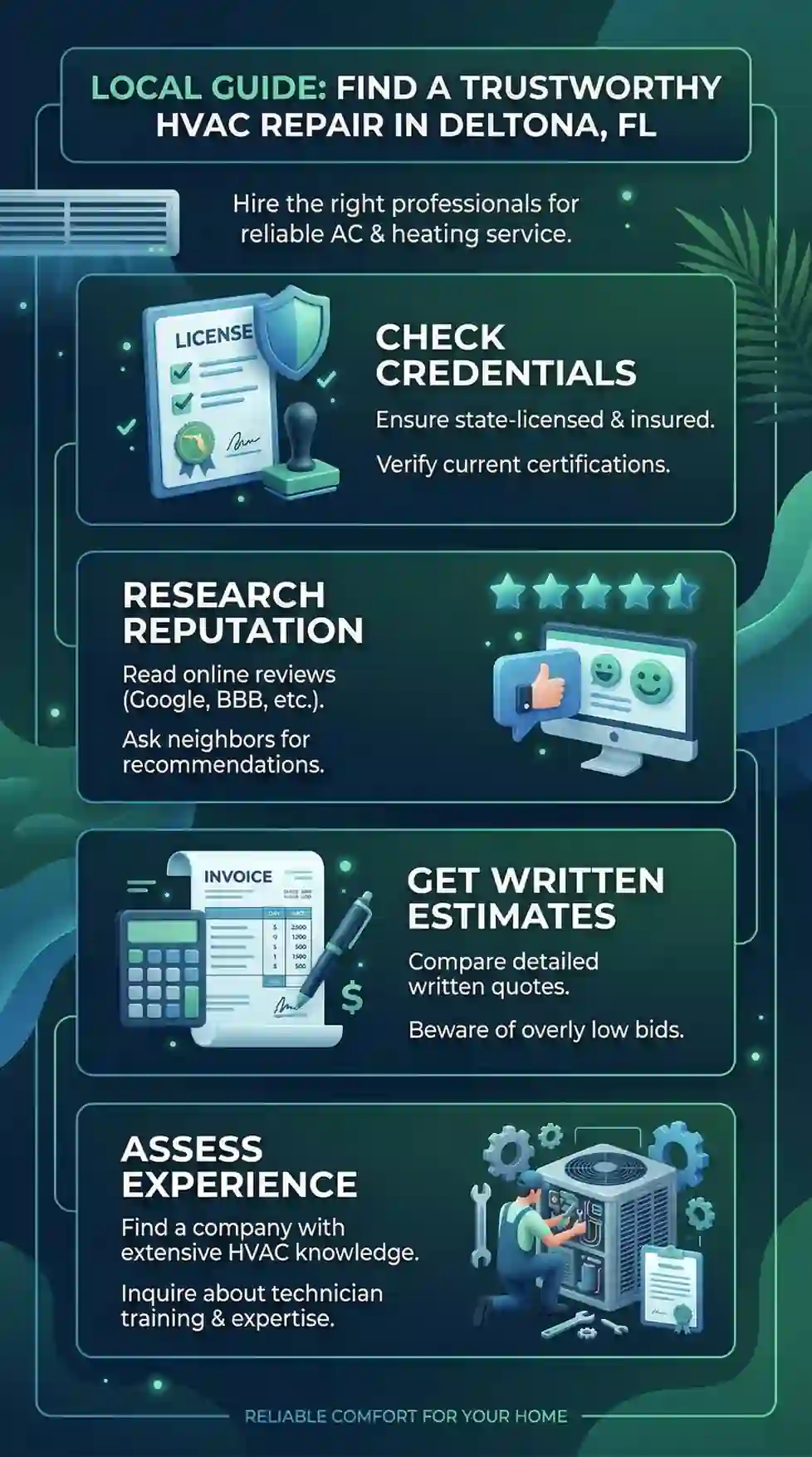
FAQ on Finding a Trustworthy HVAC Repair Company Near Deltona, FL
Q: What credentials should I verify before hiring an HVAC contractor in Deltona?
A: Run three verifications — not one. Most homeowners who call us after a bad contractor experience skipped at least one of these:
Florida DBPR license — Verify active status at myfloridalicense.com before the conversation goes further.
Volusia County registration — State licensing and county registration are separate requirements. Both matter for work in this market.
NATE certification — Ask which technician will perform the diagnostic and confirm they hold current certification.
What each credential actually tells you:
DBPR license: The contractor cleared Florida's minimum bar to operate.
Volusia County registration: The contractor is authorized to work in this specific market.
NATE certification: The technician diagnosing your system has been independently tested beyond the state licensing exam.
In our experience, the homeowners most likely to call us after a previous contractor left them worse off are the ones who stopped at step one.
Q: How do I know if an HVAC contractor in Deltona is being honest with me?
A: Honest contractors show it before the work begins — not after. Four signals are visible in every legitimate contractor interaction:
They provide a written, itemized estimate — parts, labor, permits, and warranty terms clearly separated.
They raise permit requirements without being asked.
They present repair and replacement as parallel options when both are legitimate.
They answer credential questions without hesitation or deflection.
Watch for these conversation patterns:
Contractor volunteers permit requirements unprompted → good sign.
The contractor presents both repair and replacement costs side by side → good sign.
Contractor hesitates on license number or technician certification → warning sign.
The contractor bundles everything into a single price without explanation → warning sign.
In our experience, the contractors who slow down on any of the four points above are telling you something worth paying attention to before you authorize a dollar of work.
Q: What are the biggest red flags when hiring an HVAC repair company near Deltona?
A: The red flags that cost Deltona homeowners the most money rarely arrive with obvious warning labels. From our years in this market, treat these signals seriously:
Individual red flags:
Verbal quote with no written documentation to follow.
Single bundled price with no line-item breakdown.
Full system replacement recommended on the first visit — no repair option presented.
Price significantly below every other estimate, with no explanation.
No mention of permits for system replacement or major component work.
Escalating warning signs:
Pressure to authorize work before comparing estimates or verifying credentials.
The contractor becomes difficult to reach after the deposit clears.
When two or more of these appear together, they form a pattern we'd flag immediately for any neighbor who described it to us.
Q: Why do permits matter so much for HVAC work in Deltona, and how do I know if my contractor is pulling them?
A: Permits are the most commonly skipped protection in the HVAC process — and the one most frequently exploited to cut contractor costs at a homeowner's expense.
What permitted work provides in Volusia County:
Independent inspection confirming work meets Florida Building Code.
Legal protection for your home's resale value.
Confirmation that homeowner's insurance remains valid for the work performed.
A documented record that the installation was completed correctly.
What skipping permits actually means:
The contractor is moving risk from their ledger onto yours.
The work won't be independently inspected.
You may face complications at resale or during an insurance claim.
The simplest test before authorizing any work:
Ask directly: "Will you be pulling a permit for this job?"
Trustworthy contractor: answers yes without hesitation.
Any other response: that is the answer you needed.
We've seen how unpermitted work plays out for Deltona homeowners at resale and during insurance claims. It is never worth the short-term savings.
Q: What should a trustworthy HVAC repair estimate in Deltona actually include?
A: A trustworthy estimate never arrives as a single number. From years of reviewing repair quotes with Deltona homeowners, here is exactly what separates a legitimate estimate from one that isn't:
What every honest estimate must include:
Line-item breakdown of every part being replaced, with its function briefly noted.
Labor cost separated clearly from parts cost.
Permit requirements and costs, if applicable to the scope of work.
Parts and labor warranty terms stated explicitly — not implied.
Clear description of what the repair addresses and what it does not.
Name and certification status of the technician performing the work.
What a single-number estimate signals:
The contractor is asking for blind trust before work begins.
There is no basis for evaluating whether the price reflects honest work.
If the repair fails to resolve the problem, there is no documentation of what was agreed to.
A written itemized estimate is not a formality. It is the only foundation a repair outcome worth trusting is built on.
Choosing the right contractor becomes much easier when homeowners know what signals to look for, which is exactly what How to Find a Trustworthy HVAC System Repair Company in Deltona FL helps explain. The article outlines how licensing, transparent estimates, and proper diagnostics separate reliable service providers from those who simply offer quick fixes. It also highlights how routine maintenance—such as replacing clogged filters—can prevent many service calls in the first place. Options like 20x30x1 pleated HVAC furnace air filters help maintain proper airflow and reduce unnecessary system strain. Likewise, 10x20x1 MERV 8 HVAC AC furnace air filters provide dependable filtration that supports consistent performance in Florida’s demanding climate. Homeowners can also consider replacement HVAC furnace air filters to keep their systems operating efficiently between service visits. Keeping filtration up to date complements the guidance in the article and helps Deltona homeowners reduce avoidable repairs while maintaining a reliable HVAC system.