When you’re looking for top HVAC system repair near Clermont FL, you deserve a contractor who can describe your neighborhood before they describe their pricing. We’ve serviced systems across all three of Clermont’s ZIP codes (34711, 34714, 34715) for years, from the older subdivisions along US-27 to the master-planned developments out toward Hartwood Marsh Road. The same care we’d want for our own families.
TL;DR Quick Answers
top HVAC system repair near Clermont FL
We provide same-day and next-day HVAC repair across Clermont's three ZIP codes (34711, 34714, 34715) and surrounding Lake County. Every service call includes:
Florida DBPR-licensed and NATE-certified technicians
A written estimate before any work begins
Local fluency with Kings Ridge, Greater Hills, and the newer Clermont communities
Honest repair-versus-replace guidance for systems past their 12th summer
Top Takeaways
In Clermont, capacitor and contactor failures, refrigerant leaks, condensate drain clogs, and blower motor wear account for most summer breakdown calls.
Florida HVAC equipment typically runs 10–15 years before major repair-or-replace decisions, and original units in 1995–2005 Kings Ridge and Greater Hills homes are now well past that window.
Always verify a contractor’s Florida DBPR license, ask about NATE certification, and get a written estimate before any work begins.
Repair-versus-replace isn’t a one-line answer. Walk through system age, refrigerant type, and current repair cost together before deciding.
A failing capacitor caught early is a small repair. The same failure caught after a full breakdown costs significantly more.
Why HVAC Systems Fail Most in Clermont Summers
Down here, an air conditioner never gets a real off-season. Add attic temperatures that regularly hit 130–140°F in Lake County, plus the constant humidity off Lake Minneola, Lake Minnehaha, and Lake Louisa, and equipment ages faster than the manufacturer’s chart says it should.
Five problems show up on most of our Clermont summer calls: failed start or run capacitors, pitted contactors, slow refrigerant leaks at the line set, clogged condensate drains backing water into the air handler, and blower motor wear that shows up as weak airflow before the system stops cooling altogether. In Kings Ridge, Greater Hills, and Heritage Hills homes built between 1995 and 2005, we still find original air handlers running well past their useful life and flex ducts that’s gone soft from decades of heat soaking.
What Happens on a Service Call
When we arrive, the first thing we do is listen. The homeowner usually notices the problem days before any gauge can confirm it, and that history matters more than people realize. The rest of the visit moves through a sequence we’ve refined over years of Lake County repair work:
Visual and electrical inspection of the outdoor condenser, indoor air handler, and thermostat.
Capacitor and contactor test, since those account for the largest share of “won’t start” calls in Clermont.
Refrigerant pressure check at both ports, with leak detection if pressures read low.
Condensate drain inspection and clearing, because a clogged drain can shut a system down even when nothing is mechanically broken.
Blower motor and evaporator coil check, since reduced airflow shows up as a comfort problem long before it shows up as a breakdown.
Parts confirmation and a written estimate before any repair starts. No surprises.
Repair, post-repair test cycle, and a walk-through with the homeowner before we leave.
A typical residential repair runs one to three hours from start to finish, and a top HVAC repair service keeps homeowners informed throughout the process by clearly explaining the issue, setting realistic timelines, and letting you know up front if a part needs to be ordered instead of pulled off the truck.
How We Think About Repair Versus Replace
This is the most common question we get on a service call, and there isn’t a one-line answer. The conversation we have at the kitchen table covers a few real variables:
Age of the system. Florida service life runs 10–15 years for most central AC equipment, sometimes shorter for original-build units in 1995–2000 Kings Ridge homes that have run hard since installation.
Refrigerant type. Systems still on R-22 are increasingly expensive to recharge because of long-running EPA phase-down rules. R-410A equipment manufactured before January 1, 2025 can still be installed under current EPA flexibilities, and the industry is moving toward lower-GWP A2L refrigerants like R-454B.
Repair cost relative to system age. We use a simple rule of thumb. When the repair cost multiplied by the system’s age starts approaching the price of a new system, replacement gets harder to argue against.
That’s the whole framework. It’s the same conversation we’d have with a neighbor at the back fence, and it’s the same conversation we have on every service call where the unit is past 12 years old.
How to Choose a Local Clermont Contractor
Before you sign anything, here’s what we’d check first:
Florida DBPR contractor license. Anyone working on residential HVAC in Florida should have a license you can look up by name in under a minute, in the state’s public portal.
NATE-certified technicians. North American Technician Excellence is the working-tech credential that actually maps to skill on a service call.
General liability insurance and bonding. Don’t accept verbal confirmation. Ask to see proof.
Local fluency. A real local contractor can describe Kings Ridge construction or the difference between Heritage Hills and Greater Pines duct typology without prompting.
Written estimates before work begins. Verbal quotes that shift at the end of the visit are the single most common complaint we hear from homeowners switching providers.
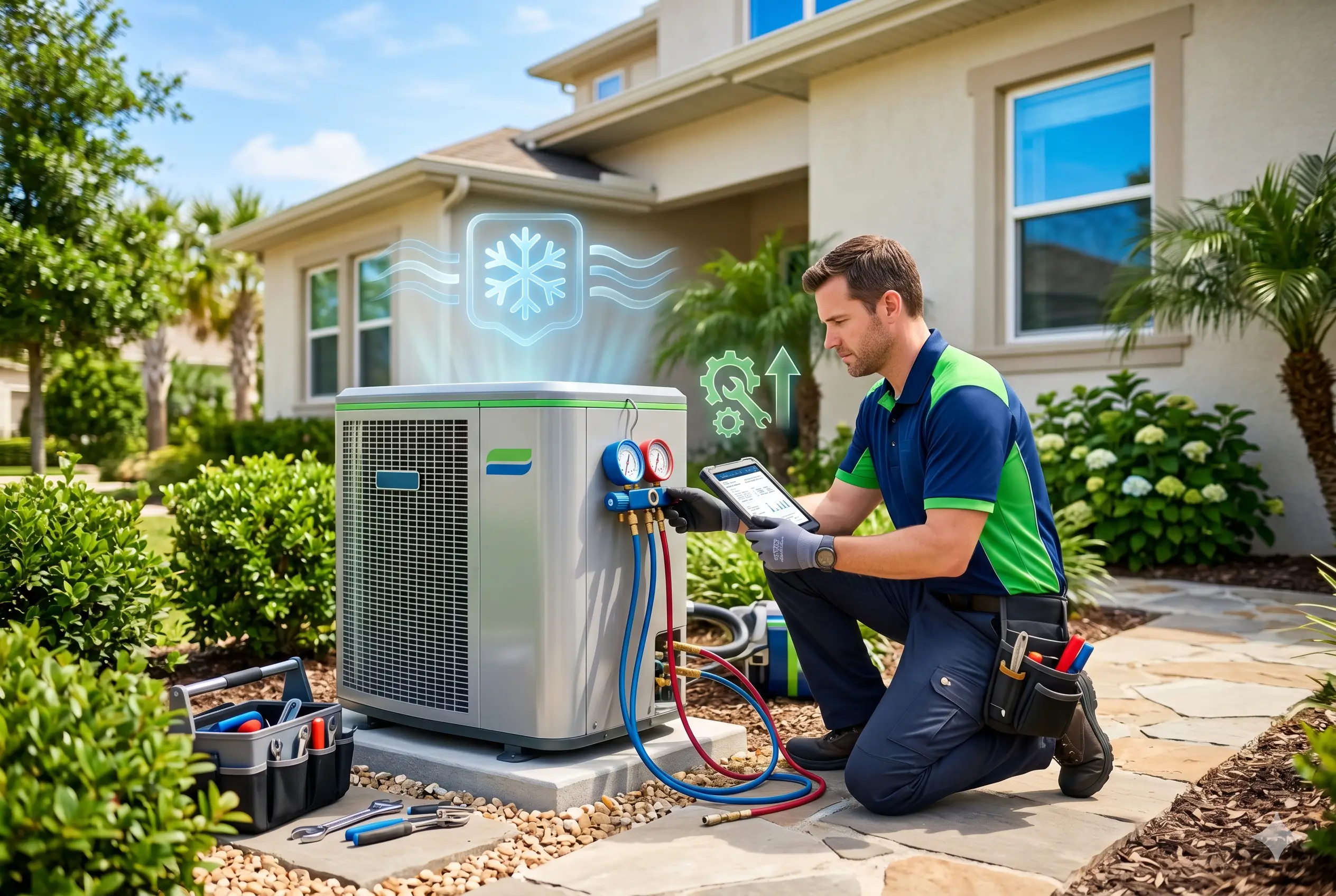
“The homes I service most often in Kings Ridge and Greater Hills are running their second- or third-generation air handlers now, and the failure pattern is almost always the same. The capacitor goes first because Central Florida attic heat cooks it long before the manufacturer’s rated life, and the contactor pits a few service calls behind it. By the time a homeowner calls us, the system has usually been short-cycling for a week. Catching it at that stage is a $200 repair instead of a $1,500 one.”
7 Essential Resources
These are the links we share with neighbors who want to do their own research before deciding on repairs. We checked each one live before publishing this page.
Heating, ventilation, and air conditioning (Wikipedia). A neutral overview of HVAC fundamentals, useful for understanding the terms a technician will use during a service call. Read the article.
Florida DBPR — License Verification Portal. Look up any Florida HVAC contractor by name or license number to confirm active status, complaint history, and bonding. Verify a license.
NATE — North American Technician Excellence. Industry-standard technician certification body. The homeowner page explains what NATE certification covers and how to find a NATE-certified contractor. Visit NATE.
ENERGY STAR — Heat & Cool Efficiently. Practical homeowner guidance on filter changes, duct sealing, smart thermostats, and when to replace older equipment. Read the guide.
U.S. Department of Energy — Air Conditioning. Plain-English explanations of how central AC works, SEER and EER ratings, and current refrigerant transitions. Read the guide.
EPA — Homeowner FAQ on Refrigerants. Direct answers on R-22, R-410A, and what the refrigerant transition means if you’re repairing or replacing equipment in 2026. Read the FAQ.
Clermont, Florida (Wikipedia). Geographic and civic context for the city, including ZIP coverage (34711, 34714, 34715) and the Lake County setting that drives our local service patterns. Read the article.
These trusted resources help homeowners confidently choose a top HVAC system repair service by providing reliable information on HVAC fundamentals, technician certifications, Florida license verification, refrigerant regulations, energy efficiency, and local Clermont service considerations that all contribute to better repair decisions and more dependable system performance.
3 Supporting Statistics
A few numbers worth knowing, straight from the agencies that publish this data. They shift how we think about HVAC repair and replacement decisions, especially for a Florida climate.
88% of U.S. homes have air conditioning, and 66% have central systems. AC isn’t a luxury system in this country. It’s standard residential infrastructure, and in Florida it runs nearly year-round. U.S. Department of Energy.
Air conditioners use about 12% of the electricity in U.S. households. In Florida, that share runs higher because cooling demand is heavier and longer than the national average. U.S. Department of Energy.
Sealing and insulating ducts can improve heating and cooling system efficiency by as much as 20 percent. That’s one of the cheapest fixes a Clermont homeowner can make for real comfort gains, especially in 1995–2005 housing stock where flex ducts have aged. ENERGY STAR.
Final Thoughts and Opinion
Clermont’s climate doesn’t give homeowners a lot of room to procrastinate. A capacitor starting to fail in May becomes a full breakdown in July, and by then the calendar is the problem, not the part.
Our honest take after years of service calls in Lake County: spring tune-ups prevent more summer emergencies than anything else we do. And if your system is already past its 12th Clermont summer, start the repair-versus-replace conversation now, before a 96°F breakdown narrows your options.
The math gets clearer when you’re not under pressure. Sometimes the answer is another two years of repairs, and sometimes a new system makes more sense. We’ll tell you which one we’d do if it were our own house.
Frequently Asked Questions
Why is my AC blowing warm air in Clermont?
In Central Florida, the most common causes are a failed capacitor, low refrigerant from a slow leak, a frozen evaporator coil from restricted airflow, or a tripped outdoor disconnect. With attic temperatures running 130–140°F in summer, capacitors are the first thing we check on a warm-air call because they fail earlier here than the manufacturer’s service life suggests.
How much does HVAC repair cost in Clermont, FL?
Costs vary by part, system age, and refrigerant type. Common repairs like capacitor replacements, contactor swaps, and condensate drain clears sit at the lower end of the range, while refrigerant leak repairs and compressor replacements are at the higher end. We give written estimates before any work starts, so you see the number before the wrench moves.
How fast can a technician come out in Clermont?
In peak summer, same-day service is the goal for any home without functioning AC, and we prioritize calls where indoor temperatures are climbing or there are vulnerable residents (infants, elderly, anyone with respiratory conditions). Off-peak, next-day or two-day service is the norm. We confirm a window when you call, not a vague “sometime today.”
What HVAC issues are most common in Central Florida summers?
Capacitor failure, contactor pitting, slow refrigerant leaks, condensate drain clogs, and blower motor wear. The order shifts from year to year, but those five account for the bulk of our Clermont service calls. Year-round runtime is the underlying driver, made worse by attic heat that cooks capacitors and the constant humidity rolling off the chain of lakes.
Should I repair or replace a 10-year-old AC in Florida?
It depends on the repair cost, the refrigerant type, and how the system has been maintained. A well-kept 10-year-old R-410A system with a $300 repair is worth keeping. A poorly maintained 10-year-old R-22 system with a $1,500 repair is a different conversation. We walk through both scenarios on the service call so you can decide without pressure.
How do I know if my AC compressor is failing?
Four signs to watch for: a hard start (a loud thunk when the unit kicks on), the outdoor unit running while the air inside stays warm, breakers tripping when the AC starts, or visible oil residue around the compressor. Compressor diagnosis still needs gauges and electrical measurement, though those four signs are reliable indicators that a tech should take a look.
Do I need a licensed contractor for HVAC repair in Florida?
Yes. Florida law requires that HVAC contractors hold an active license through the Florida DBPR (Department of Business and Professional Regulation). You can verify any contractor’s license at MyFloridaLicense.com in under a minute. Unlicensed work can void manufacturer warranties and create insurance complications if something fails later.
Reliable HVAC Repair, Right Here in Clermont
Small problems cost less than big ones, especially with a Florida summer working against the equipment. Schedule a Clermont HVAC repair visit and a licensed local technician will be at your door with a written estimate in hand before any work starts.
During Florida’s hottest months, airflow problems and dirty filters are some of the most common causes of emergency cooling issues. In Reliable HVAC Repair Near Clermont, FL for Summer Breakdowns, we explain how preventative maintenance and proper airflow management can help homeowners avoid costly mid-summer system failures. Replacing worn filters with products like 24x30x1 pleated furnace filters, 14x20x1 MERV 8 HVAC air filters, and pleated AC replacement filters can help improve airflow, reduce strain on critical HVAC components, and support more reliable cooling performance throughout Clermont’s long summer season.