If you rent or manage an apartment in Altamonte Springs, the HVAC system is working harder than the thermostat suggests — and failing in patterns that repeat across Seminole County with enough consistency that we can predict them before a service call is ever placed.
What separates apartment HVAC in Altamonte Springs from the rest of the country isn't a single factor — it's the combination. Near-year-round demand. Sustained humidity above 80% for months at a stretch. Shared-wall construction that restricts airflow and concentrates heat. Aging infrastructure maintained on property-wide service schedules that rarely account for the individual stress each unit places on its own system. In our years servicing Seminole County apartment communities, that combination produces the same failure points — in the same sequence — more reliably than any other market we operate in.
The HVAC issues common to Altamonte Springs apartments aren't random. They're the predictable output of a specific climate operating on a specific building type. Understanding that pattern is the difference between catching a $150 capacitor before it becomes a $1,500 compressor — and finding out what nine months of Florida humidity did to a system that nobody checked.
This page covers the failure patterns we see most consistently across Altamonte Springs apartment communities, why Central Florida's climate accelerates them faster than national maintenance guides account for, and what tenants and property managers can do to keep systems running efficiently, including when it makes sense to rely on top HVAC system repair near Altamonte Springs FL to restore comfort fast, prevent repeat breakdowns, and protect your apartment’s air quality before small issues turn into expensive problems.
TL;DR Quick Answers
What HVAC Issues Are Common in Altamonte Springs Apartments?
What makes apartment HVAC in Altamonte Springs different:
Systems run 8–10 months per year in sustained humidity above 80%
Shared-wall construction restricts airflow and concentrates heat
Responsibility gaps between tenants and property management leave filters unchanged for entire lease cycles
Aging 1990s–2000s equipment operating beyond designed service life in near-year-round demand
Five most common issues:
Clogged condensate drain lines — most consistent complaint across Seminole County apartment communities
Restricted airflow from neglected filters — most consistent source of preventable component failures
Refrigerant imbalances in aging equipment — surfaces as comfort complaints before outright failure
Thermostat and electrical issues — more prevalent in shared-wall buildings with aging infrastructure
Evaporator coil deterioration — accelerated by sustained humidity feeding biological growth year-round
What property managers can do now:
Flush condensate drains monthly during peak cooling season — not quarterly
Clarify filter change responsibility in lease agreements and verify during unit inspections
Treat recurring service calls on the same unit as a pattern — not isolated incidents
Schedule pre-season inspections in September before emergency premiums apply
What tenants should watch for:
Water near the air handler — report immediately, escalates faster in Florida humidity than expected
Musty odors when system runs — biological growth requires professional remediation, not a filter change
System cycling more frequently or running longer than normal — early intervention costs significantly less than failure
The one thing that separates well-maintained Altamonte Springs apartment HVAC from expensive HVAC: Pre-season attention in September or October — before Florida's climate converts a predictable maintenance gap into an emergency service call.
Top Takeaways
Florida's climate makes HVAC maintenance more consequential — not less.
Altamonte Springs systems run 8–10 months per year in sustained humidity above 80%
Near-year-round demand accelerates component wear faster than moderate climates produce
Nothing looks wrong until it already is — that's what makes Seminole County's climate uniquely deceptive
The most expensive repair calls in Altamonte Springs are almost always preventable.
Compressor failures trace back to ignored capacitors
Capacitor failures trace back to restricted filters
Multi-unit water damage claims trace back to clogged condensate drains
The repair bill reflects a maintenance gap — not a sudden failure
Pre-season inspection in September or October catches those gaps before they become emergency calls
Credential verification is the most important step before scheduling any HVAC repair.
Verify active Florida DBPR license at myfloridalicense.com before anyone enters your home
Confirm EPA Section 608 certification before any refrigerant work begins
In a workforce growing at nearly twice the national average, baseline credentialing matters more now than five years ago
Written diagnostics and root-cause accountability separate top companies from the rest.
Verbal estimates with no documentation are the most consistent red flag across Seminole County service calls
Ask one question before authorizing any repair: are you fixing what failed — or finding out why it failed?
Symptom treatment without root-cause correction almost always produces a repeat service call
The best time to act is before you need to.
September and October: standard rates, flexible scheduling, components caught before they fail
December and January: emergency premiums, compressed scheduling, same components — after they've already failed
Pre-season timing is the single most financially consequential maintenance decision an Altamonte Springs homeowner can make
The HVAC Challenges Altamonte Springs Apartments Face That Other Markets Don't
Most national HVAC guides are written for climates that give systems a break. Altamonte Springs doesn't. From what we've seen across Seminole County apartment communities, the combination of near-year-round demand, sustained humidity, and shared-wall construction creates a failure environment that standard maintenance schedules — written for moderate climates — simply aren't designed to address.
The result is a predictable set of problems that surface in Altamonte Springs apartments with enough regularity that experienced technicians can anticipate them before a service call is ever placed.
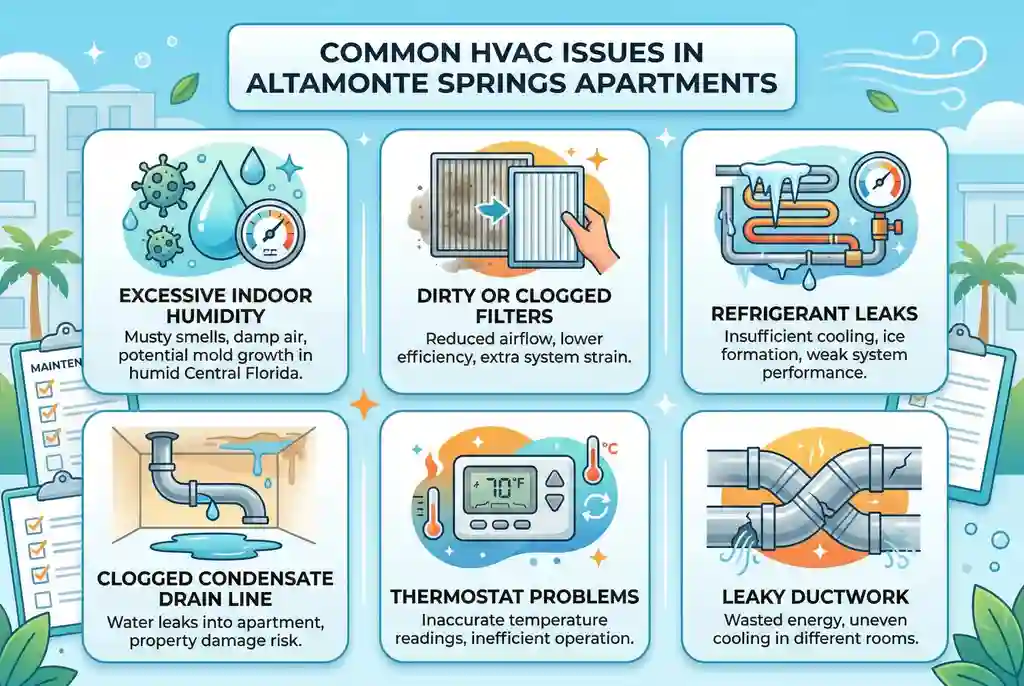
Clogged Condensate Drain Lines
The most consistent HVAC complaint we receive from Altamonte Springs apartment tenants isn't a failed compressor or a refrigerant leak. It's water — water pooling around the air handler, water staining ceiling tiles, water triggering the float switch that shuts the system down entirely on the hottest afternoon of July.
The source is almost always the same: a condensate drain line clogged with algae, mold, or debris. In Altamonte Springs' sustained humidity, air handlers pull enormous volumes of moisture out of the air during cooling cycles. That moisture has to go somewhere — and in an apartment building where drain lines run through shared infrastructure and maintenance schedules apply building-wide rather than unit by unit, blockages accumulate faster than most property managers account for.
Left unaddressed, a clogged condensate drain doesn't just shut down one unit. In multi-story buildings, it creates water intrusion that affects the units below it. A $15 maintenance flush becomes a multi-unit water damage claim with enough regularity across Seminole County that we consider condensate drain maintenance the single highest-return preventive action an Altamonte Springs property manager can take.
Restricted Airflow From Neglected Filters
Apartment HVAC filters present a specific challenge that single-family homes don't: responsibility gaps. Tenants assume property management handles filter changes. Property management assumes tenants handle filter changes. In the gap between those two assumptions, filters go unchanged for months — sometimes an entire lease cycle — while the system quietly absorbs the consequences.
A heavily restricted filter forces the blower motor to work harder to move the same volume of air. The blower running hotter than designed accelerates capacitor stress. A capacitor degrading under added thermal load fails under peak demand — typically on the first genuinely hot day of spring or the first cold night of January, when the system is asked to perform at maximum output for the first time in weeks.
From our service history across Altamonte Springs apartment communities: the majority of capacitor replacements we perform trace directly back to a filter that should have been changed two to three months earlier. The repair bill reflects the filter change that didn't happen — not the component that failed — and it’s a good reminder that reliable HVAC repairs are often about smart prevention and quick, accurate fixes that keep systems running smoothly, reduce repeat breakdowns, and maintain consistent comfort for residents.
Refrigerant Imbalances From Aging Equipment
Altamonte Springs apartment communities built in the 1990s and early 2000s represent a significant portion of Seminole County's rental inventory. Many of those buildings still operate original or near-original HVAC equipment — systems designed for R-22 refrigerants that's no longer manufactured, running in a climate that demands near-year-round performance from equipment approaching or exceeding its designed service life.
What that produces in practice: systems that cool inconsistently, cycle more frequently than normal, run longer without reaching set temperature, and draw more power doing it. Tenants experience it as comfort complaints. Property managers receive it as a steadily increasing volume of service calls on the same units — each one treated as an isolated incident rather than a pattern pointing toward the same underlying condition.
Refrigerant imbalances in aging Altamonte Springs apartment equipment rarely announce themselves dramatically. They surface gradually — in utility bills trending upward, in comfort complaints that don't resolve after filter changes, in systems that seem to be working but never quite perform the way they should. By the time the system fails outright, the efficiency loss has been compounding for months.
Thermostat and Electrical Issues Unique to Shared Buildings
Apartment HVAC systems operate in an electrical environment that single-family systems don't — shared panels, aging wiring infrastructure, voltage fluctuations that affect multiple units simultaneously, and thermostat configurations that may have been modified by previous tenants or maintenance personnel across multiple lease cycles.
From our service calls across Seminole County apartment communities, thermostat and electrical issues surface in two consistent patterns. The first is straightforward: thermostats miscalibrated or improperly configured that cause systems to short-cycle, run continuously, or fail to respond to temperature demands accurately. The second is less visible: wiring issues that produce intermittent failures — systems that work when the technician arrives and fail again two days later — because the underlying electrical condition wasn't isolated during the initial diagnostic.
Both patterns are more common in Altamonte Springs apartment buildings than in single-family homes, and both are more likely to affect multiple units when the root cause runs through shared building infrastructure.
Evaporator Coil Deterioration Accelerated by Florida Humidity
Evaporator coils in Altamonte Springs apartment systems operate in one of the most demanding moisture environments in the country. Sustained outdoor humidity above 80% for months at a stretch, combined with near-year-round cooling demand, means coils are continuously pulling moisture from the air at a rate that systems in moderate climates never experience.
The result is accelerated biological growth — mold and mildew establishing on coil surfaces — and in older systems, accelerated corrosion on copper coil components from sustained formicary corrosion, a specific degradation pattern driven by interaction between copper, moisture, and organic compounds present in Florida's air.
What tenants notice first: musty odors when the system runs, reduced cooling performance, or visible moisture around the air handler. What the coil actually reflects is months of sustained biological and chemical deterioration in a climate that accelerates both faster than property maintenance schedules — written for moderate climates — are typically calibrated to address.
What Tenants and Property Managers Can Do Now
The HVAC issues common to Altamonte Springs apartments share a consistent characteristic: they're predictable, and most of them respond to maintenance timing more than maintenance cost. From our years across Seminole County apartment communities, the actions that prevent the most expensive outcomes are rarely complicated.
For tenants:
Change or request filter changes every 30–60 days — not the 90-day interval recommended for moderate climates
Report water near the air handler immediately — condensate drain blockages escalate faster in Florida humidity than most tenants expect
Note and report comfort complaints early — a system cycling more frequently or running longer than normal is communicating a condition that's easier and less expensive to address before it becomes a failure
For property managers:
Establish condensate drain flushing on a monthly schedule during peak cooling season — not a quarterly one
Clarify filter change responsibility explicitly in lease agreements and verify compliance during unit inspections
Treat recurring service calls on the same unit as a pattern requiring root-cause diagnosis — not a series of isolated repairs
Schedule pre-season inspections in September before heating demand creates compressed scheduling and emergency premiums across Seminole County
The gap between a well-maintained Altamonte Springs apartment HVAC system and an expensive one is almost never a single catastrophic failure. It's a series of small maintenance gaps that Florida's climate converts into repair bills — predictably, consistently, and on a timeline that pre-season attention almost always interrupts before the bill arrives.
"Apartment HVAC in Altamonte Springs doesn't fail the way most maintenance guides predict. Systems run eight to ten months a year in sustained humidity that moderate markets never produce, inside buildings where a single unaddressed condensate drain affects the unit below it and a neglected filter becomes a compressor failure two months later. After years of service calls across Seminole County apartment communities, the pattern is consistent: the expensive outcomes are almost never sudden. They're predictable conditions that the maintenance schedule wasn't calibrated to catch. The property managers who fare best aren't the ones with the largest budgets — they're the ones who understand that Florida's climate runs on a different timeline than the maintenance calendar most apartment communities are still using."
Essential Resources
1. Verify Your HVAC Contractor's License Before Anyone Enters Your Home
Florida DBPR License Verification https://www.myfloridalicense.com/wl11.asp
We tell every Altamonte Springs homeowner the same thing before scheduling any service — including with our own team: verify the license first. Florida law requires active DBPR licensure for any contractor legally performing HVAC work in this state, and two minutes on this portal tells you more than any marketing material a company produces.
Confirms active license status for any contractor serving Altamonte Springs and Seminole County
Legitimate companies provide their license number without being asked
First and most reliable verification step before any repair or replacement work begins
2. Confirm Refrigerant Certification Before Any Heat Pump Service
EPA Section 608 Technician Certification https://www.epa.gov/section608/section-608-technician-certification
Most homes in Altamonte Springs run on heat pumps — systems that handle refrigerant in both heating and cooling modes. We hold EPA Section 608 certification across our technician team because federal law requires it, and because we'd encourage any homeowner we serve to ask for that documentation before refrigerant work begins on any system we touch or that anyone else touches.
Federal requirement for any technician handling refrigerant under the Clean Air Act
Applies to heat pump service in both heating and cooling modes across Altamonte Springs homes
A qualified HVAC technician produces certification documentation without hesitation — absence is grounds to pause before authorizing work
3. Know Your Local Consumer Protection Resource Before You Need It
Seminole County Consumer Protection Office https://www.seminolecountyfl.gov/offices/county-attorney/consumer-protection.stml
As neighbors who live and work in this community, we want Altamonte Springs homeowners protected — by us and by every contractor operating in Seminole County. This local resource exists for situations where a contractor's conduct crosses from poor service into something that warrants a formal response.
Local jurisdiction covering Altamonte Springs and all Seminole County communities
Formal complaint process for contractor disputes and deceptive practices
First local escalation point before engaging state-level consumer protection resources
4. Report Deceptive HVAC Practices Directly to the Florida Attorney General
Florida Attorney General Consumer Protection — File a Complaint https://www.myfloridalegal.com/consumer-protection/consumer-complaint-form
The Florida AG's office has taken formal action against multiple HVAC companies statewide for unnecessary repairs, refrigerant upselling, and high-pressure replacement tactics. We share this resource because we believe homeowners who know their options before a bad experience make better decisions throughout the process — including who they call in the first place.
State-level complaint process for deceptive contractor conduct across Florida
Florida AG has established documented precedent acting against HVAC companies statewide
Formal filing creates a recorded complaint beyond local dispute resolution
5. Check Available Rebates Before Committing to HVAC Replacement
ENERGY STAR Rebate Finder https://www.energystar.gov/rebate-finder
When a repair conversation becomes a replacement conversation — something we approach honestly and without pressure — this is the first place we point Altamonte Springs homeowners before any decision is made. Enter your zip code and surface what's currently available on certified heat pumps and qualifying equipment before authorizing work.
Returns current federal and local rebate opportunities by Altamonte Springs zip code
Applies to ENERGY STAR certified heat pumps and qualifying HVAC replacement equipment
Replacement decisions made without checking available incentives frequently leave significant money unclaimed
6. Duke Energy Customers: Confirm Rebate Eligibility Before Replacement Work Begins
Duke Energy Florida Home Energy Improvement Rebates https://www.duke-energy.com/home/products/home-energy-improvement
Duke Energy Florida customers in the Altamonte Springs area may qualify for meaningful rebates on qualifying heat pump replacements — but the eligibility window closes once replacement work is complete. We walk our customers through this before any replacement is scheduled because we'd rather you keep that money than leave it on the table.
Available to Duke Energy Florida customers in the Altamonte Springs service area
Requires a free Home Energy Check before replacement work is authorized
Rebate eligibility cannot be applied retroactively — confirm before work begins, not after
7. Verify Contractor Reputation Through Documented Service History
Better Business Bureau — Accredited HVAC Contractors Altamonte Springs https://www.bbb.org/us/fl/altamonte-springs/category/heating-and-air-conditioning
BBB accreditation reflects something review platforms alone don't surface: a contractor's documented commitment to respond formally to customer complaints. For Altamonte Springs homeowners comparing contractors, BBB profiles reveal complaint volume, resolution patterns, and local operating history — the kind of track record that only comes from years of standing behind your work in the same community.
Confirms contractor's accountability to documented conduct standards beyond star ratings
Review complaint volume and resolution patterns — not just the letter grade
Local operating history reveals the kind of community stability that newer or out-of-area contractors simply can't replicate
Supporting Statistics
Statistic 1: Heating and cooling account for 52% of the energy used in a typical U.S. home. U.S. Energy Information Administration — Residential Energy Consumption Survey https://www.eia.gov/energyexplained/use-of-energy/homes.php
What this means in Altamonte Springs specifically:
Most Seminole County homes run entirely on electric heat pumps — no gas furnace, no seasonal split in the load
The same unit cooling from March through November switches to heating for 6–8 weeks and starts again
No off-season. No recovery window. Near-year-round demand on a single system
What we've seen directly:
Walked into Altamonte Springs homes where a heat pump ran 20% below optimal efficiency for months
No failed component, no warning light, no single bill that looked obviously wrong
Refrigerant slightly off, capacitor thermally stressed, filter unchanged since the previous season
System quietly costing the homeowner money every day it ran — across the largest energy expense line in the home
Why the 52% figure matters more here than in moderate markets:
In climates with true off-seasons, inefficiency has a natural reset point
In Altamonte Springs, invisible inefficiency compounds across 8–10 months of continuous operation
The gap between an optimally performing system and a degraded one shows up in utility bills long before it shows up in a service call
Statistic 2: A dirty air filter can increase HVAC energy consumption by up to 15%. U.S. Department of Energy — Energy Saver: Maintaining Your Air Conditioner https://www.energy.gov/energysaver/maintaining-your-air-conditioner
What 15% actually means across an Altamonte Springs operating season:
Applied to a system running 8–10 months per year, a single neglected filter becomes a sustained efficiency penalty across nearly every month of operation
The consequences run deeper than the utility bill
The failure sequence we see most consistently across Seminole County service calls:
Restricted filter forces the blower motor to work harder than designed
Blower running hotter than designed places sustained thermal stress on the capacitor
Capacitor degrading under that stress reaches its limit on the first peak demand moment of the season
System fails on the hottest afternoon of April or the first cold night of January
What we find when we arrive:
The filter that created the conditions for the failure is almost always still in the system
Nobody changed it
The 15% efficiency penalty is where the sequence starts
The $300 capacitor replacement — or the compressor failure that follows — is where it ends
The pattern across Altamonte Springs service calls:
Most expensive repairs we run in this market trace directly back to a filter that should have been changed 2–3 months earlier
The repair bill reflects the maintenance that didn't happen — not just the component that failed
Statistic 3: Employment of HVAC technicians is projected to grow 9% from 2023 to 2033, faster than the average for all occupations, with about 40,400 openings projected each year. U.S. Bureau of Labor Statistics — Occupational Outlook Handbook https://www.bls.gov/ooh/installation-maintenance-and-repair/heating-air-conditioning-and-refrigeration-mechanics-and-installers.htm
What rapid workforce growth means for Altamonte Springs homeowners:
The pool of available technicians is expanding faster than the industry's consistent capacity to credential and train all of them to the same standard
Growth at nearly twice the national average for all occupations creates real variation in diagnostic discipline, local knowledge, and accountability
What separates technicians in this market from our experience across Seminole County:
The difference between finding the root cause and addressing only the visible symptom almost never comes down to the repair itself
It comes down to diagnostic discipline, local climate knowledge, and the accountability that follows verifiable credentials
A company's reputation in a market like Altamonte Springs is built one service call at a time — and that history is verifiable before anyone enters your home
What credential verification actually protects:
Florida DBPR license and EPA Section 608 certification don't guarantee the best technician
They establish a baseline of legal accountability that protects you when something goes wrong
In a workforce growing at this rate, that baseline matters more now than it did five years ago
Our standard — and the standard we'd encourage you to apply to any company you call:
Verify active Florida DBPR license at myfloridalicense.com before scheduling
Confirm EPA Section 608 certification before any refrigerant work begins
We verify our own team's credentials the same way we encourage you to verify ours — before anyone enters your home, not after
These statistics reinforce why top HVAC system repair is a proactive advantage, not just a fix—because strong diagnostics, timely filter changes, and verified technician credentials protect the biggest energy load in the home, prevent small inefficiencies from compounding, and keep comfort reliable while avoiding the high costs that follow delayed decisions.
Final Thought & Opinion
The most important thing we've learned after years of service calls across Altamonte Springs isn't technical. It's timing.
Florida's climate doesn't make HVAC maintenance optional — it makes it deceptive.
Mild winters create the impression heating systems can be ignored until they're needed
Near-year-round cooling seasons normalize the idea that a system running continuously is a system running correctly
Sustained humidity makes component degradation invisible until it's already expensive
The homeowners who fare best in this market aren't the ones with the newest systems. They're the ones who understand that Altamonte Springs operates on a different maintenance timeline than the calendar most households are still running on.
What that looks like from our years across Seminole County:
The capacitor failing in January was weakening in September — pre-season inspection catches it at a fraction of emergency call cost
The $1,200–$2,800 compressor replacement traces back to a $15–$20 filter change that didn't happen two months earlier
The multi-unit water damage claim started as a $15 condensate drain flush nobody scheduled in July
The December refrigerant recharge was a gradual imbalance visible in utility bill trends months before the system failed
Our honest opinion after serving this community:
Most HVAC problems in Altamonte Springs aren't HVAC problems. They're maintenance gaps Florida's climate converts into repair bills — predictably, consistently, and on a timeline that pre-season attention almost always interrupts before the bill arrives.
The calls that catch homeowners most off guard aren't caused by systems working too hard. They're caused by systems nobody checked — sitting through nine months of Seminole County humidity with degrading components, failing the first time genuine demand was placed on them.
Before authorizing any HVAC repair in Altamonte Springs:
Verify active Florida DBPR license at myfloridalicense.com before scheduling
Confirm EPA Section 608 certification before any refrigerant work begins
Request written diagnostics before authorizing any repair
Ask whether the repair addresses root cause or visible symptom
Ask what pre-season inspection would have cost versus what you're looking at now
The answer to that last question — in our experience across this market — is almost always the most clarifying number in the conversation.
FAQ on What HVAC Issues Are Common in Altamonte Springs Apartments?
Q: What are the most common HVAC problems in Altamonte Springs apartments?
A: After years of service calls across Seminole County, the failure patterns we see aren't random. They're predictable — and they repeat with enough consistency that experienced technicians can anticipate them before arriving on site.
Most common issues in order of frequency:
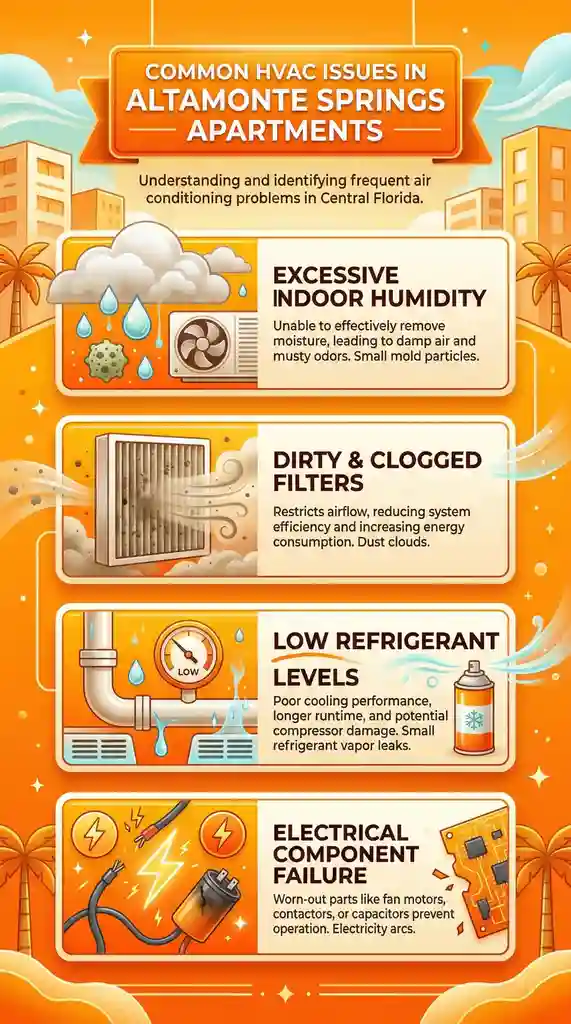
Clogged condensate drain lines — the single most consistent complaint we receive. Near-year-round cooling cycles pull enormous moisture volumes through drain infrastructure that moderate climates never stress the same way.
Restricted airflow from neglected filters — worsened by the responsibility gap between tenants and property management that leaves filters unchanged for entire lease cycles.
Refrigerant imbalances in aging equipment — particularly in communities built in the 1990s and early 2000s still running original systems through 8–10 month operating seasons.
Thermostat and electrical issues — more prevalent in shared-wall buildings with aging wiring infrastructure modified across multiple lease cycles.
Evaporator coil deterioration — accelerated by sustained humidity above 80% feeding biological growth and corrosion on copper coil components.
What connects all five:
Every issue is predictable
Every issue responds to maintenance timing more than maintenance cost
Most become expensive only after Florida's climate converts a small condition into a large one
Q: Why do Altamonte Springs apartments have more HVAC problems than single-family homes?
A: Three factors combine in apartment buildings that single-family homes don't produce — and Central Florida's climate amplifies all three.
1. Responsibility gaps create maintenance voids.
Tenants assume property management handles filter changes
Property management assumes tenants handle it
Filters go unchanged for months — sometimes an entire lease cycle
We've walked into Altamonte Springs units where the original move-in filter was still in the system a year later
The system doesn't announce this — it runs harder, runs hotter, and degrades faster
2. Shared infrastructure turns one unit's problem into the building's problem.
A clogged condensate drain in one unit creates water intrusion in the unit below
Aging wiring through shared panels affects multiple units simultaneously
A single unaddressed condition escalates into a multi-unit event faster in shared-wall construction than any single-family equivalent
3. Aging equipment under near-year-round demand degrades faster than the calendar suggests.
Many Altamonte Springs communities built in the 1990s and early 2000s still run original or near-original equipment
A system at end of designed service life running 8–10 months per year in Seminole County humidity has been stressed harder than the same-age system in a moderate climate
Isolated comfort complaints almost always reflect a pattern pointing toward the same underlying condition across multiple units
Q: How often should HVAC filters be changed in Altamonte Springs apartments?
A: Every 30–60 days — not the 90-day interval on most filter packaging. The 90-day recommendation is one of the most consistently damaging maintenance assumptions we encounter across Seminole County apartment communities.
Why the standard interval fails in Altamonte Springs:
Systems running 8–10 months per year accumulate particulate load faster than the 90-day guideline was designed to address
Sustained humidity above 80% accelerates biological growth on filter media faster than dry climates
Shared-wall construction restricts airflow — systems work harder, pulling more particulate through filters faster
The failure sequence a neglected filter sets in motion:
Restricted filter forces blower motor to work harder than designed
Blower running hotter places sustained thermal stress on the capacitor
Capacitor degrades and fails on first peak demand moment of the season
Filter that caused it is almost always still in the system when we arrive
What the numbers look like:
A 90-day filter in Altamonte Springs performs like a 5–6 month filter in a moderate climate
A $15–$20 filter change skipped becomes a $150–$300 capacitor replacement
Filter interval is the single highest-return maintenance decision available to Seminole County apartment communities
Q: What should Altamonte Springs property managers do to prevent expensive HVAC repairs?
A: The actions that prevent the most expensive outcomes aren't complicated. They're about calibrating maintenance schedules to what Florida's climate actually demands — not what national guidelines written for moderate markets suggest.
Four highest-return actions from our years across Altamonte Springs apartment communities:
Flush condensate drains monthly during peak cooling season — not quarterly.
A $15 flush prevents the multi-unit water damage claim that costs multiples of that to remediate
The most expensive water damage claims in apartment HVAC almost always start with a drain line nobody flushed
Clarify filter change responsibility in lease agreements — then verify it.
The tenant-management responsibility gap is the most consistent source of preventable component failures we see
Written responsibility confirmed during unit inspections closes the gap that converts a $15 filter change into a $300 repair call
Treat recurring service calls on the same unit as a deterioration pattern — not isolated incidents.
Two or more significant repairs in a single season reflects an underlying condition — not independent failures
Root-cause diagnosis on the third call costs less than funding a fourth
Sequential symptom repairs almost always cost more than a single diagnostic evaluation at the start of the season
Schedule pre-season inspections in September — before heating demand compresses scheduling.
September: standard rates, flexible scheduling, components caught before they fail
January: emergency premiums of $75–$150 above standard rates, every HVAC company in Seminole County at full capacity
The timing difference isn't marginal — it's the difference between catching the condition and paying for the failure
Q: How can Altamonte Springs apartment tenants tell if their HVAC system needs professional repair?
A: Not every HVAC complaint requires a service call. But the signals that warrant professional attention are consistent enough across our years in Seminole County that we can outline them clearly.
Check these before requesting a repair:
Thermostat set correctly and responding to temperature adjustments
Filter condition — a restricted filter resolves more comfort complaints than most tenants expect
Vents and return grilles fully open and unobstructed
Breaker panel — heat strips and air handlers run on separate breakers, a tripped breaker is one of the most common first cold-season calls we run
Signals that warrant a professional service call:
Water pooling around the air handler or ceiling tile staining — condensate blockages escalate faster in Florida humidity than most tenants expect, and the unit below finds out before you do
Musty or moldy odors when the system runs — biological growth on evaporator coils requires professional remediation, not a filter change
System cycling more frequently or running longer without reaching set temperature — early indicators of refrigerant imbalance or capacitor stress that cost significantly less to address before failure
No heating output on first cold nights — often a reversing valve issue or heat strip problem that developed silently across 9 months of dormancy
Unusual sounds during operation — rattling, grinding, or persistent clicking are mechanical warnings that surface before failure, not after
What the timing difference actually costs:
Complaints reported at first sign almost always cost less than ones reported after a full season under a degrading condition
Early intervention vs. delayed response in Altamonte Springs is almost always measured in hundreds of dollars
Same underlying condition — different repair bills — based entirely on when the call was placed
In What HVAC Issues Are Common in Altamonte Springs Apartments?, we break down how restricted airflow, high humidity, clogged condensate lines, and overworked blower motors are among the most frequent problems in multi-unit buildings where systems run long hours in a humid climate. Many of these issues start with something simple: neglected filtration that limits airflow and forces components to work harder than designed. Replacing a worn filter with the correct size—such as a 15x20x1 pleated furnace filter, a properly fitted 16x18x1 MERV 8 HVAC air filter, or a compatible 16x25x4 MERV 13 air filter for thicker media cabinets—helps maintain steady airflow and reduce strain on shared systems. In apartment settings where small performance drops compound quickly, consistent filtration and early diagnostics often prevent the larger breakdowns that tenants and property managers want to avoid.