Denver’s air runs on two different clocks. Summer ozone cooks up in the afternoon sun. The winter Brown Cloud settles in before dawn and waits for a breeze to clear it. I lined up Colorado’s forecast calendars against its alert records, and that split showed up again and again. Once you know which clock is running, you’ll know when to throw the windows open and when to let your home’s filter carry the load.
TL;DR Quick Answers
denver air quality
Denver air quality changes with two pollution seasons. Ground-level ozone builds on hot summer afternoons, and winter inversions trap carbon monoxide and fine particles close to the ground on calm, cold mornings. April and October usually bring the cleanest air, and a MERV 8 pleated HVAC filter can help capture some of the particles that make their way indoors. The metro still ranks 8th worst in the nation for ozone.
Summer ozone: Colorado forecasts ozone daily from May 31 to August 31, and readings peak in the afternoon and early evening.
Winter Brown Cloud: Inversions hold pollution thickest near dawn between November and March.
Best time outside: Go out early on summer days and after lunch on winter days.
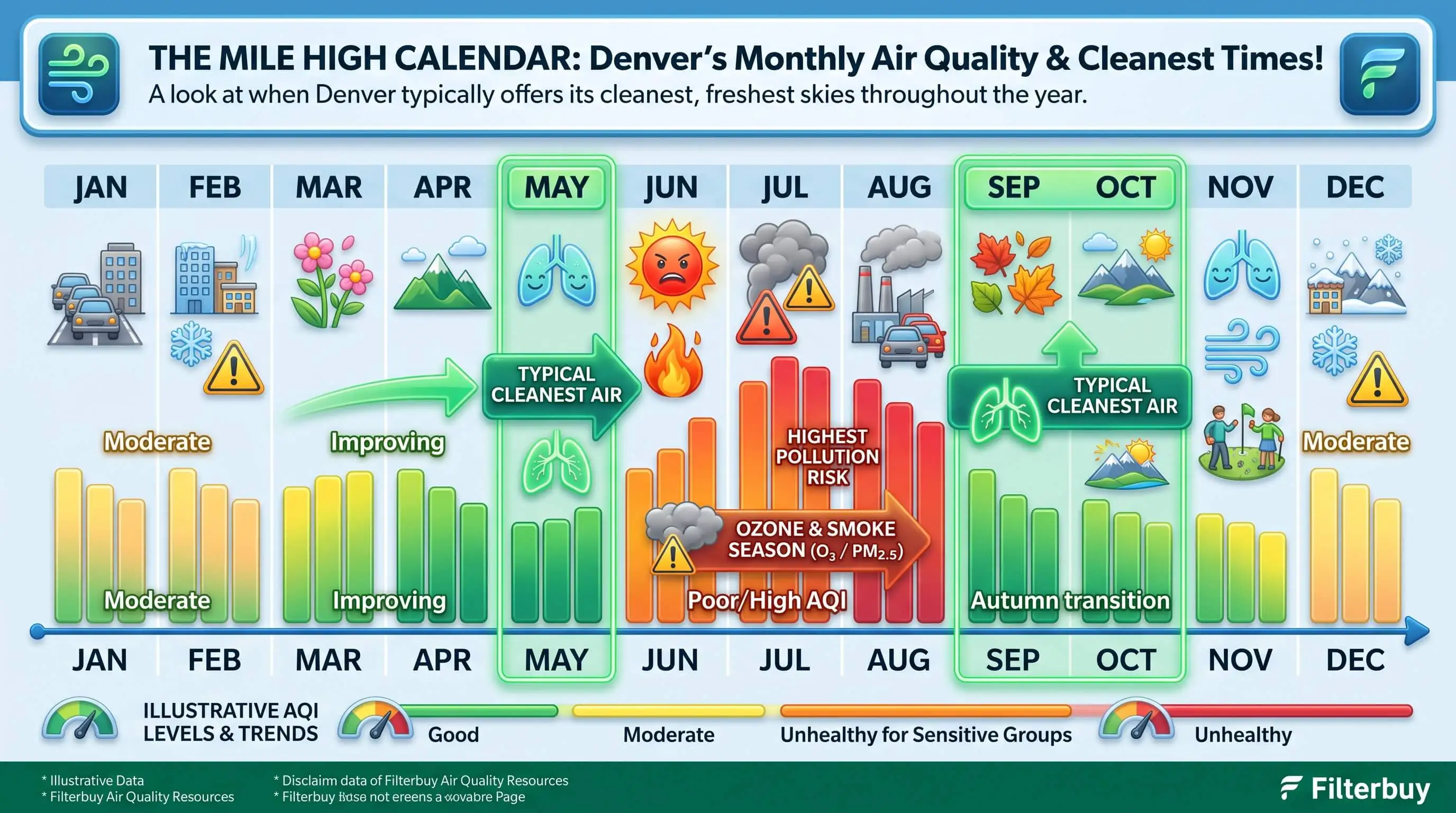
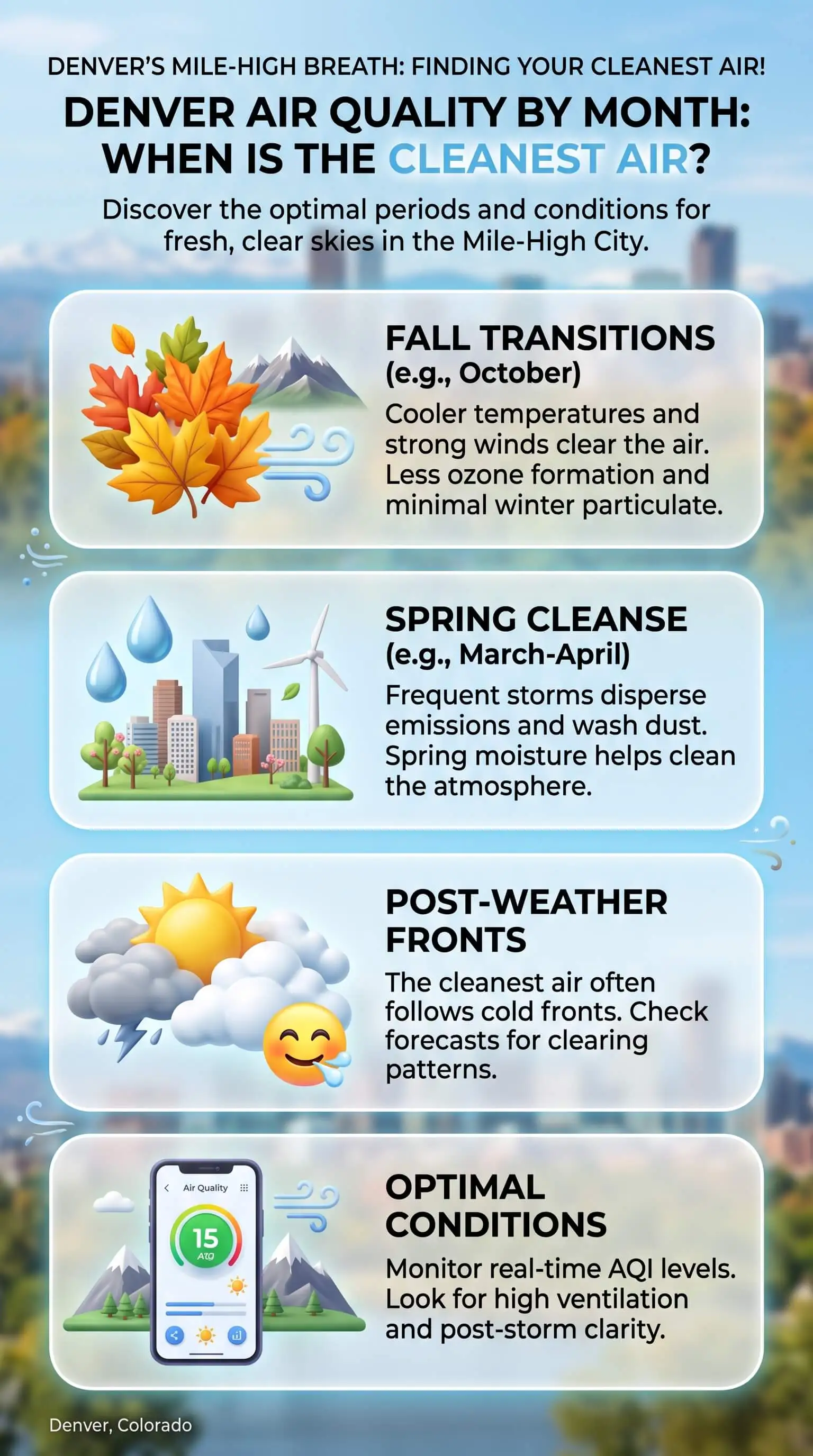
Cleanest months: April, plus late September through October.
Indoor air: Put in a fresh filter before November, and check it monthly through July, August, and any smoky week.
Top Takeaways
• Two seasons: Summer brings ozone, and winter brings inversions that trap fine particles and carbon monoxide.
• Cleanest windows: April, plus late September through October.
• Timing: Head outside early on summer days and after lunch on winter days.
• Early ozone: Colorado issued ozone alerts in mid-May in both 2025 and 2026.
• Indoor follows outdoor: Line up filter checks with November, June, and the peak summer months.
Why Denver Has Two Pollution Seasons
Summer belongs to ground-level ozone. It forms when nitrogen oxides and volatile organic compounds from cars, gas-powered equipment, and industry react in heat and sunlight. Wildfire smoke can speed that reaction along.
Winter works differently. On calm, cold days, a lid of warmer air settles over the city and holds down whatever tailpipes and chimneys put out, mostly carbon monoxide and fine particles. Locals call that haze the Brown Cloud.
Denver has come a long way. Back in the 1970s and early 1980s, the city broke federal air standards up to 200 days a year. Today it meets every standard except one. Ozone is the holdout, and it keeps the metro near the top of the national ozone rankings, making top air filters a useful consideration for managing particles that enter the home.
Denver Air Quality Month by Month
I pieced this year together from state forecast calendars and recent alert records. Use it to plan, and check the live reading before any big outdoor day.
January: Inversion Mornings and Wood Smoke
Cold, calm mornings trap pollution close to the ground, and the haze can hang around until midday. On winter Action Days, the state restricts residential wood burning across the seven-county metro.
February: Cold, Still, and Hazy at Dawn
More of January’s pattern. Haze stacks up over a run of still days until a windy afternoon or a passing storm scrubs it out.
March: Wind Returns and the Air Clears
Wind is March’s gift to Denver’s lungs. Gusty days mix the air and break up inversions, and the state’s winter advisory season ends March 31. Expect some dust, but multi-day pollution stretches get rare.
April: The Spring Clean-Air Window
My pick for the best breathing month in Denver. Inversions have faded and the ozone season hasn’t started yet. Tree pollen and the odd stratospheric intrusion, when ozone from high in the atmosphere drops to street level behind a cold front, are about the only nuisances.
May: Pollen and the First Ozone Alerts
Ozone doesn’t wait for the official season. Colorado issued ozone alerts on May 10 and May 13 in 2025, then called an Action Day on May 11, 2026.
June: Ozone Season Opens
The state’s daily ozone forecasts start May 31, and the 2026 alert program kicked off June 1. Longer days mean more afternoon ozone. Fire season across the West starts adding smoke, too.
July: Peak Ozone and Smoke Risk
Good luck finding a clean July afternoon. Heat, strong sun, and light winds push ozone into the Unhealthy for Sensitive Groups range on many afternoons and evenings, and the western metro and foothills usually read highest.
August: Hot Afternoons and Smoke Overlap
August can hit you with both problems at once. On August 7 and 8, 2026, ozone and fine particles climbed together, Colorado called a multi-pollutant Action Day, and one monitor logged an ozone AQI of 108.
September: Ozone Fades, Smoke Can Linger
Ozone eases as the days shorten. Smoke from distant fires can still drift in, but by late September most days read clean.
October: The Fall Clean-Air Window
Denver’s second sweet spot. Ozone season has ended, inversion season hasn’t fully arrived, and the state’s winter pollution forecasts don’t start until Halloween.
November: Inversion Season Returns
The winter High Pollution Advisory program opens November 1. Shorter days and more furnace and fireplace use bring the morning haze back.
December: Brown Cloud Mornings
The coldest month carries the most inversion risk. Check the forecast before you light a fire, because burning restrictions kick in on Action Days.
The Best Time of Day to Breathe Easier in Denver
The clock matters nearly as much as the calendar. One of the most useful air quality facts in Denver is that summer ozone builds through the afternoon and peaks into the evening, so Colorado’s health department steers outdoor plans toward mornings or late evenings. Winter flips that. An inversion holds pollution thickest in the early morning, and the air usually clears by afternoon once the sun warms the ground and the breeze picks up.
Here’s how I plan around it. I run early all summer and save winter walks for after lunch.
How Each Season Reaches the Air Inside Your Home
Don’t take your indoor air for granted! Fine particles slip in around windows and doors, and your heating and cooling system pulls air across its filter every time it cycles. You can’t see any of it happening. The filter catches what it can, and it’s the one part of Denver’s air you control completely, which makes you the hero of your household’s air.
I tie filter checks to Denver’s calendar. A fresh filter goes in before November’s inversion season, I check it in June, and I check it every month through July, August, and any smoky week. A MERV 13 furnace filter catches far more fine particles than a basic filter, as long as your system can handle one.
Before you open the windows on a nice day, pull up Denver’s live air quality map. It tells you whether the air outside is actually cleaner than the air inside.
“After years reading Front Range air data, the detail I push hardest is timing. Winter pollution sits in a thin layer of cold air under the inversion and peaks near dawn, while summer ozone needs hours of sunlight to form and doesn’t peak until late in the day, so the same Denver home needs a different plan in January than it does in July, something an experienced HVAC technician can also take into account when evaluating indoor air needs.”
7 Essential Resources
1. Denver Live AQI Map and Filter Guide: The real-time Denver reading I linked above, paired with a plain-English guide to matching your filter to each AQI level.
2. CDPHE: Ozone Pollution and Your Health: Colorado’s health department explains how ozone forms and who feels it most. You can also sign up for daily Front Range forecast emails here.
3. Denver’s Love My Air Program: The city’s own sensor network, with readings down to the neighborhood level.
4. EPA AirData Daily Air Quality Tracker: Compare any county’s daily AQI this year against past years. It’s the easiest way to see Denver’s two seasons for yourself.
5. AirNow: AQI Basics: What each AQI number and color means for your health and your weekend plans.
6. CDC: Safety Guidelines for Wildfire Smoke: Practical steps for keeping smoke outside and protecting the people who feel it first.
7. APHA: How to Get Ready for Wildfire Smoke: A preparedness checklist worth running before fire season starts.
Together, these resources make it easier to understand Denver air quality, track current conditions, compare seasonal patterns, and know when ozone or wildfire smoke should change how you plan outdoor time and protect the air inside your home.
3 Statistics
1. 8th worst in the nation for ozone. State of the Air 2026 ranked the Denver-Aurora-Greeley metro 8th worst for ozone and 106th for short-term particle pollution, using data from 2022 through 2024. American Lung Association
2. 33 Ozone Action Day Alerts in 2025. Thirty landed inside the official May 31 to August 31 window, and most alerts fall between mid-May and mid-September. Regional Air Quality Council
3. Up to 200 violation days a year. Denver hit that mark in the 1970s and early 1980s. Today the city meets federal standards for every pollutant except ozone. NASA Earthdata
Final Thoughts and Opinion
I’d love to see more Denver households stop treating air quality like a daily surprise. The pattern holds steady enough to plan around. Save long outdoor days for spring and fall, get moving early in summer, and wait for the afternoon in winter.
Indoor air is where I’d push hardest. Checking the AQI is a smart habit, but it only protects you if the air inside your home gets cleaned too. Swapping a filter at the right times of year is a little effort with a big impact, and it keeps working on the days you forget to look.
Frequently Asked Questions
Is Denver air quality bad in the summer?
Summer is Denver’s ozone season. Mornings usually read fine, but hot, sunny, still afternoons often push ozone into the Unhealthy for Sensitive Groups range, and Colorado called 33 alert days in 2025. Early morning is your cleanest window to get outside, while pleated furnace filters can help manage particles that make their way indoors.
Does Denver still have a brown cloud?
On some winter mornings, yes, though it’s far milder than it was in the 1970s and 1980s. A temperature inversion traps vehicle exhaust and wood smoke near the ground, and wind or a passing storm usually clears it out.
When does wildfire smoke usually affect Denver?
Smoke risk runs highest from summer into early fall, when fires burn across the West. Fires hundreds of miles away can still send smoke over the Front Range, so keep a smoke map handy during active fire periods.
How early in the year can ozone alerts start in Denver?
Earlier than most people expect. The official alert program opens around June 1, but Colorado issued ozone alerts on May 10 and 13 in 2025 and called an Action Day on May 11, 2026.
Plan Your Clean-Air Days Around Denver’s Calendar
Denver saves its cleanest air for April and October, and its summer afternoons and winter mornings ask a little more of you. Keep that calendar handy, check the live reading before big outdoor days, and choose the best air purifier for your space so you can take more control of the air your family breathes indoors.